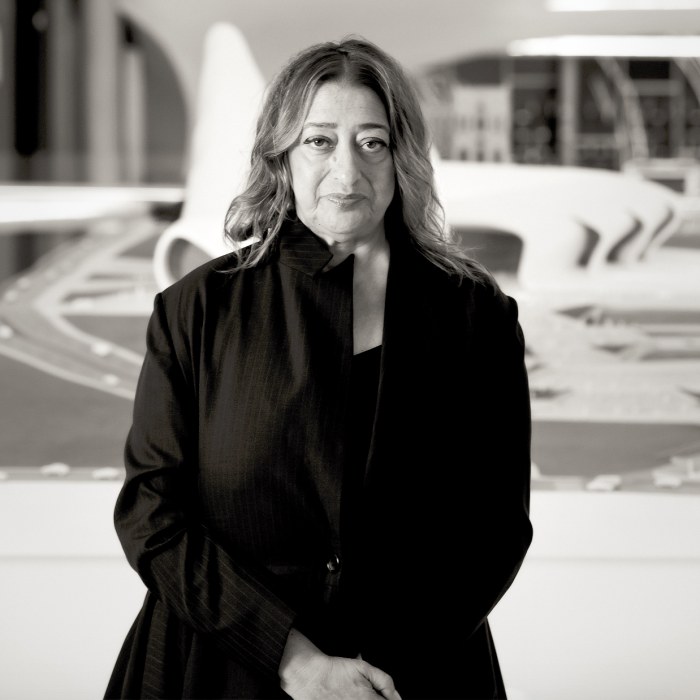
Zaha Hadid
Called a paper architect for twenty years because nobody would build her designs
Zaha Hadid was born in Baghdad to a liberal, wealthy family and grew up in a modernist house at a time when the city was full of new building. She studied mathematics at the American University of Beirut before moving to London in 1972 to train at the Architectural Association, where teachers remembered her as fierce, brilliant and impossible to categorise.
She opened her own practice in 1980 and in 1983 won the competition for The Peak, a leisure club perched above Hong Kong, with paintings of fractured, floating shards. It was never built. In 1994 she won the competition for the Cardiff Bay Opera House; the scheme was abandoned after a public campaign against it. For most of two decades she was known for drawings and exhibitions rather than buildings, and the label paper architect followed her around. She was also a woman, an Arab and blunt in meetings, and she said openly that all three counted against her.
Her first significant building, a fire station for Vitra in Germany, was finished in 1993. Then, slowly, the commissions came: a tram station, a ski jump, the MAXXI museum in Rome, the Guangzhou Opera House, the London Aquatics Centre for the 2012 Olympics.
She won the Pritzker Prize in 2004, the first woman to do so, and in 2016 became the first woman awarded the RIBA Royal Gold Medal in her own right. She died of a heart attack a few weeks later, aged 65.