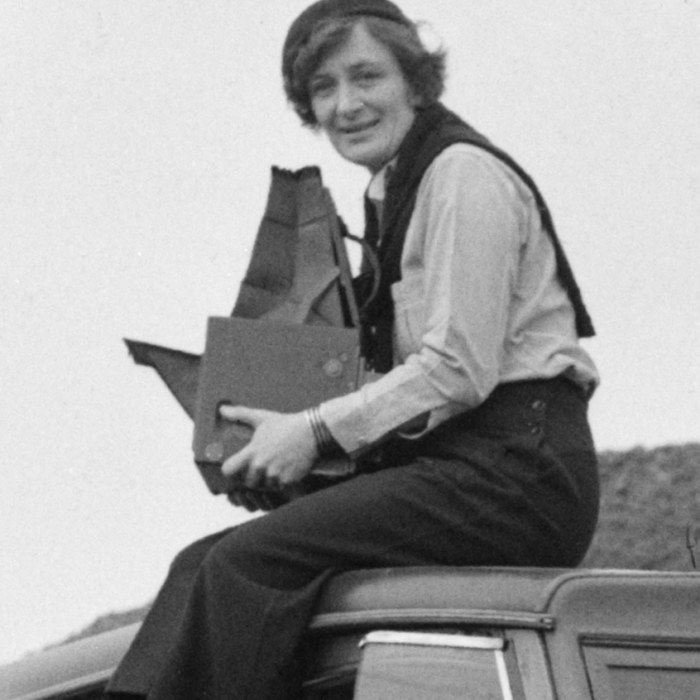
Dorothea Lange
Left lame by polio, she walked the Depression’s breadlines and gave the era its face
Dorothea Lange contracted polio at seven and was left with a withered right leg and a permanent limp. She later said it was the most important thing that happened to her: it formed her, humiliated her and taught her to notice people who were struggling. When she was twelve her father walked out, and she took her mother's surname.
She decided to be a photographer before she had ever owned a camera, learned in New York portrait studios and in 1918 set out to travel the world. She got as far as San Francisco, where her money was stolen. She stayed and opened a portrait studio that soon had the city's wealthy families as clients.
When the Depression hit she found she could no longer stay inside. Her 1933 picture of a man turned away from a breadline, White Angel Breadline, changed her career. She began working for the federal government, driving through California with the economist Paul Taylor, whom she married, documenting displaced farm families. In March 1936, at a pea-pickers' camp at Nipomo, she took a handful of frames of a hungry mother with her children. Migrant Mother became the most reproduced photograph of its era.
In 1942 she photographed the forced removal of Japanese Americans to internment camps; the army impounded her pictures. She died in 1965, weeks before a retrospective at the Museum of Modern Art that she had spent her last months selecting.