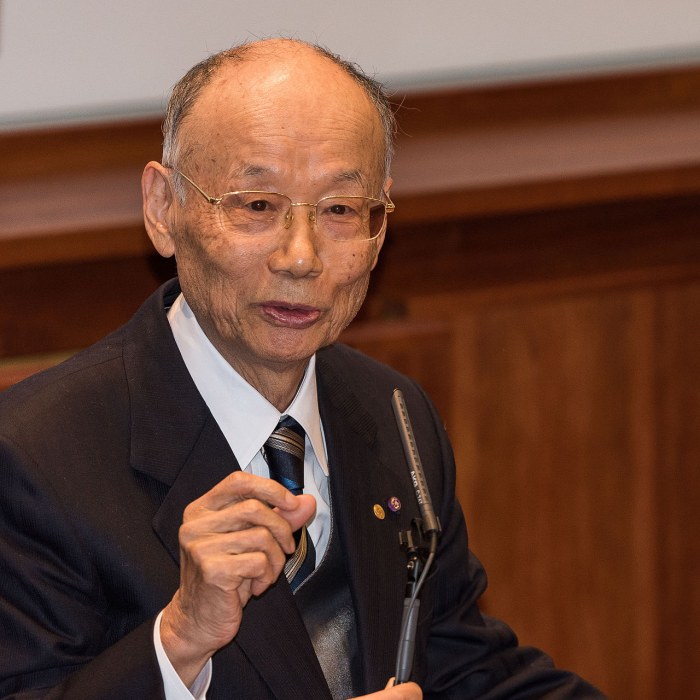
Satoshi Ōmura
Carried a plastic bag for soil samples everywhere, and one of them held a drug that has treated billions
Satoshi Ōmura was born in 1935 in Nirasaki, in the mountains of Yamanashi, the eldest son of a farming family. He was expected to work the land, and his childhood was spent helping. He got to the local university, and after graduating took a job teaching science at a night school in Tokyo. His students were young workers who came in after their shifts, and he has said their seriousness shamed him into studying properly himself, in the daytime, at a chemistry graduate school.
He joined the Kitasato Institute, where the tradition was to hunt for useful compounds among the microbes of the soil. The work is repetitive. You collect samples, culture what grows, and test what the cultures produce, mostly finding nothing. Ōmura carried a plastic bag in his pocket wherever he went and dug up a little earth. He also learned to think like a chemist about which strains were worth pursuing, which is where his skill lay.
In the 1970s one sample, from soil beside a golf course in Shizuoka, yielded a new Streptomyces bacterium. In partnership with the American parasitologist William Campbell it gave avermectin and then ivermectin, which turned out to be safe and astonishingly effective against parasitic worms. Given away free by Merck from 1987, it has almost eliminated river blindness in parts of Africa and Latin America.
He shared the Nobel Prize in 2015. He still says the credit belongs to the microbes.