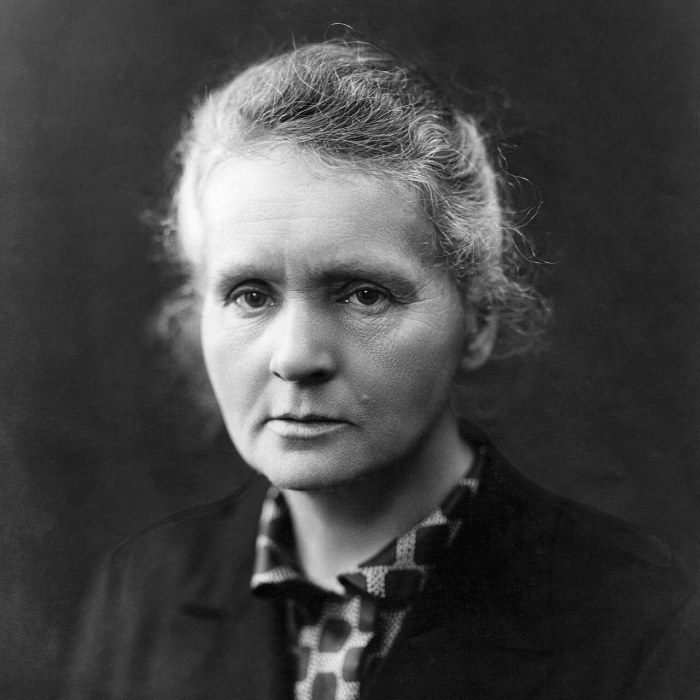
Marie Curie
Pioneer of radioactivity and the first person to win two Nobel Prizes
Maria Skłodowska grew up in Warsaw under Russian rule, in a family that valued learning but had lost most of its money. Women could not attend the University of Warsaw, so she studied at an underground "Flying University" and worked for years as a governess to pay for her sister's medical training in Paris, on the understanding that her sister would later fund hers.
When she finally reached the Sorbonne in 1891 she lived in an unheated attic, sometimes fainting from hunger, and finished first in her physics class. She married the physicist Pierre Curie and together they began investigating the strange rays given off by uranium. Working in a leaking shed, stirring vats of pitchblende by hand, she isolated two new elements, polonium and radium, and coined the word "radioactivity".
She shared the 1903 Nobel Prize in Physics with Pierre and Henri Becquerel, then won the 1911 Nobel Prize in Chemistry on her own, becoming the first person to win in two sciences. Pierre had died in a street accident in 1906, leaving her to raise two daughters and take over his professorship, the first woman to teach at the Sorbonne.
During the First World War she fitted cars with X-ray equipment and drove them to the front herself, training women to operate them. She never patented her radium process, believing it belonged to science. The decades of exposure eventually cost her her life, but her notebooks, still radioactive, are kept in lead-lined boxes to this day.