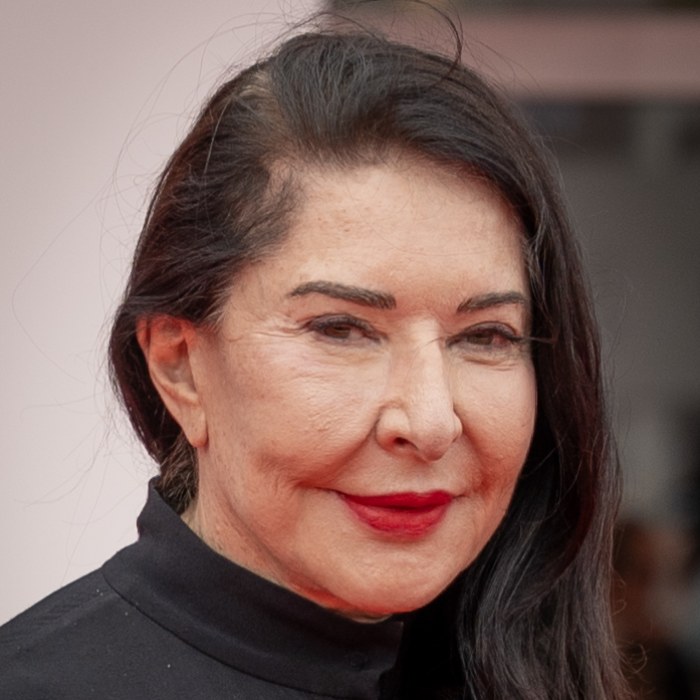
Marina Abramović
Locked in her room until 29 by a strict mother, she turned her own body into her art
Marina Abramovic was born in Belgrade to parents who had been partisan fighters and became senior figures in Communist Yugoslavia. Her mother in particular ran the household with military strictness, imposing a curfew that kept Abramovic confined to her room by ten at night until she left home at twenty nine, an upbringing she has described as shaping her fascination with control, discipline and the body.
She trained at art academies in Belgrade and Zagreb before turning fully to performance in the early 1970s, a form that let her work directly with risk rather than represent it. In pieces such as Rhythm 0, she stood motionless for six hours while inviting the audience to use any of seventy two objects on her body, including a loaded gun, testing how far people would go when given permission.
From 1976 she worked in close creative and romantic partnership with the German artist Ulay, staging performances built on trust, exhaustion and physical strain. The partnership ended in 1988 with a planned final piece: the two walked toward each other from opposite ends of the Great Wall of China, meeting once in the middle to say goodbye.
In 2010 her retrospective The Artist Is Present at New York's Museum of Modern Art saw her sit silently across a table from museum visitors for 736 hours over three months, a work that brought her performance practice to a far wider public than before.