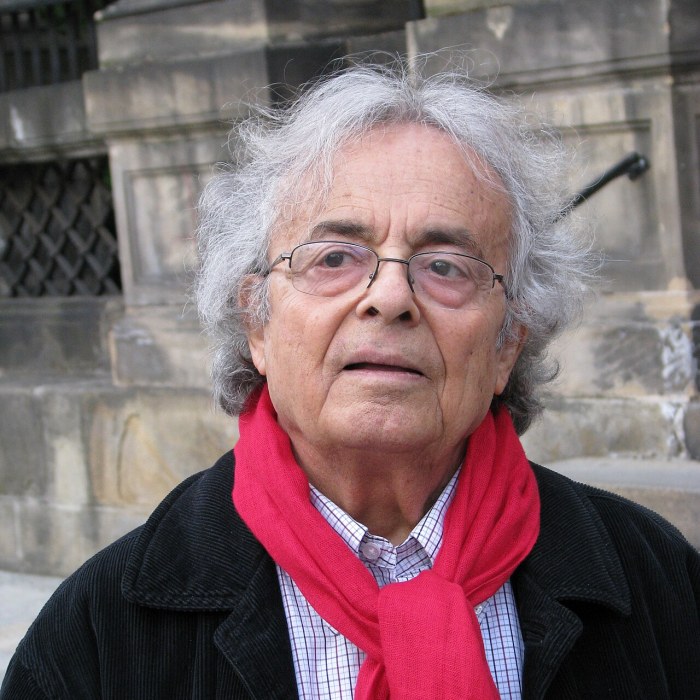
Adonis
Recited a poem to Syria's president as a farm boy and was later jailed for his politics
Ali Ahmad Said Esber, who later took the pen name Adonis, was born in a poor farming village in coastal Syria and had no access to formal schooling as a young child, teaching himself to read with his father's help. In 1944, aged around fourteen, he composed and recited a poem in front of the visiting Syrian president, Shukri al-Quwatli, an act of showmanship that won him a state scholarship to attend a proper school for the first time.
He studied philosophy at Damascus University, but his membership of the Syrian Social Nationalist Party, a movement calling for a single secular Syrian state, led to his arrest and roughly six months' imprisonment in the mid 1950s. On his release he moved to Beirut, then a freer environment for writers from across the Arab world, and became a Lebanese citizen.
In Beirut he co-founded the journal Shi'r, a platform for a new generation of poets pushing Arabic verse away from its classical metres and forms toward free verse and modernist experiment, work that made him one of the most influential and controversial figures in twentieth-century Arabic literature. He later settled in Paris.
Adonis has remained a sharp critic of authoritarianism and religious orthodoxy across the Arab world, and has been named repeatedly as a contender for the Nobel Prize in Literature without winning it.