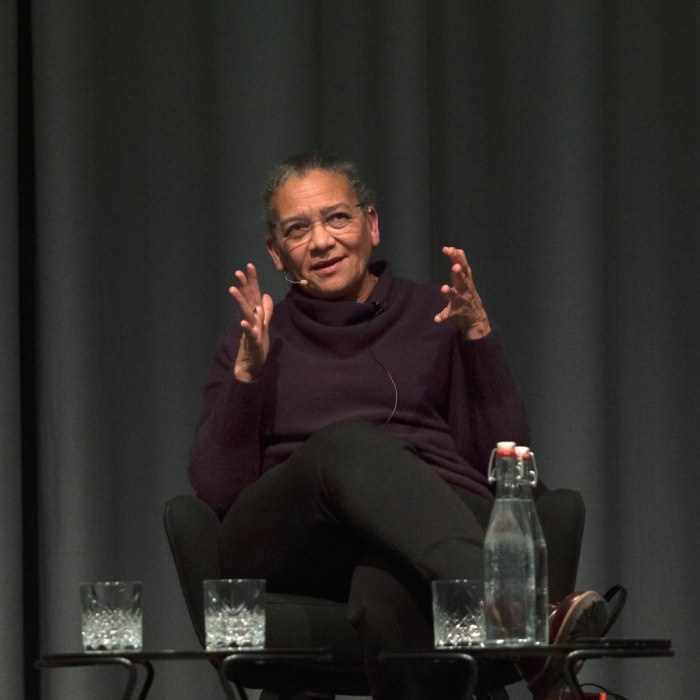
Lubaina Himid
Painted and taught for thirty years outside the art world's gaze, then won the Turner Prize at sixty-three
Lubaina Himid was born in Zanzibar in 1954. Her father, a teacher, died of malaria when she was four months old, and her mother, a textile designer, brought her to Britain. She grew up in London among fabrics and patterns, trained in theatre design at Wimbledon School of Art and took a master\'s in cultural history at the Royal College of Art, where she was the only Black student.
In the early 1980s she found that galleries had no interest in the work of Black women, so she became a curator of her own movement, organising exhibitions in borrowed spaces with titles like Five Black Women and The Thin Black Line, at the ICA in 1985, showing artists the mainstream ignored. Her own paintings and cut-out figures took the history of slavery, colonial trade and the way Black people had appeared in European art and turned them into something bright, sardonic and full of pattern.
She moved to Preston in 1990 to teach at what became the University of Central Lancashire, and stayed. For nearly three decades she worked steadily, made projects like Naming the Money, a hundred painted figures, each an enslaved servant at a European court, and was largely left out of the story of British art.
In 2017, at 63, after the Turner Prize removed its age limit, she won it, the first Black woman and the oldest person to do so. Tate Modern gave her a large exhibition in 2021. She still lives and paints in Preston.