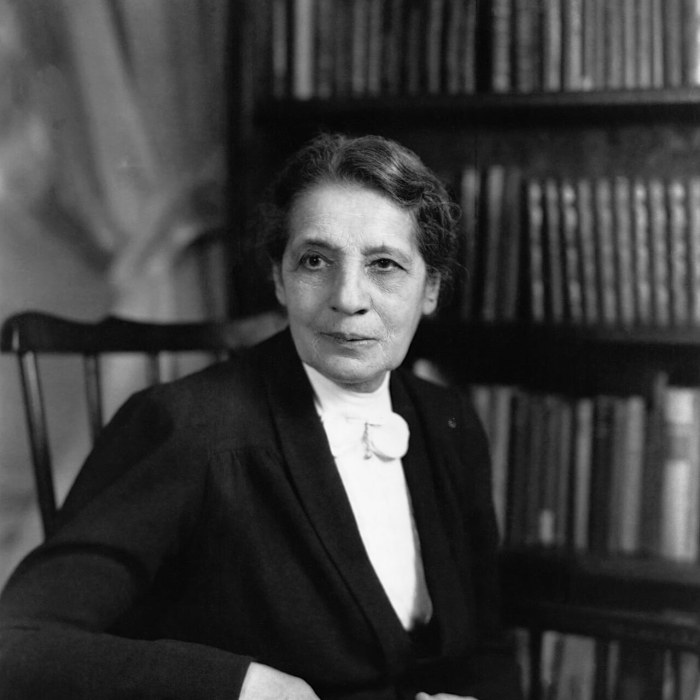
Lise Meitner
Explained nuclear fission while in exile, then refused to help build the bomb
Lise Meitner was born in Vienna in 1878 into a Jewish family with eight children. Girls in Austria could not attend the public schools that led to university, so she left formal education at 14 and prepared for the entrance exams privately, covering eight years of work in two. In 1906 she became only the second woman to earn a physics doctorate from the University of Vienna.
She moved to Berlin, where Max Planck let her sit in on his lectures, and began a partnership with the chemist Otto Hahn. The institute did not admit women, so she worked unpaid in a converted carpentry shop in the basement and used the toilets of a restaurant down the street. It took years before she had a salary and a proper title. By the 1920s she was running her own department and was regarded as one of the best nuclear physicists in Europe.
The Nazi takeover stripped her of her position. In July 1938 she escaped across the Dutch border with a few belongings; Hahn gave her his mother's diamond ring in case she needed to bribe a guard. That Christmas, walking in the snow in Sweden with her nephew Otto Frisch, she worked out that the strange results Hahn had reported meant the uranium nucleus was splitting in two. They named it fission.
Hahn alone received the 1944 Nobel Prize in Chemistry. Meitner, invited to join the Manhattan Project, refused outright. She lived on in Sweden and then England, and died in 1968. Her gravestone reads: "A physicist who never lost her humanity."