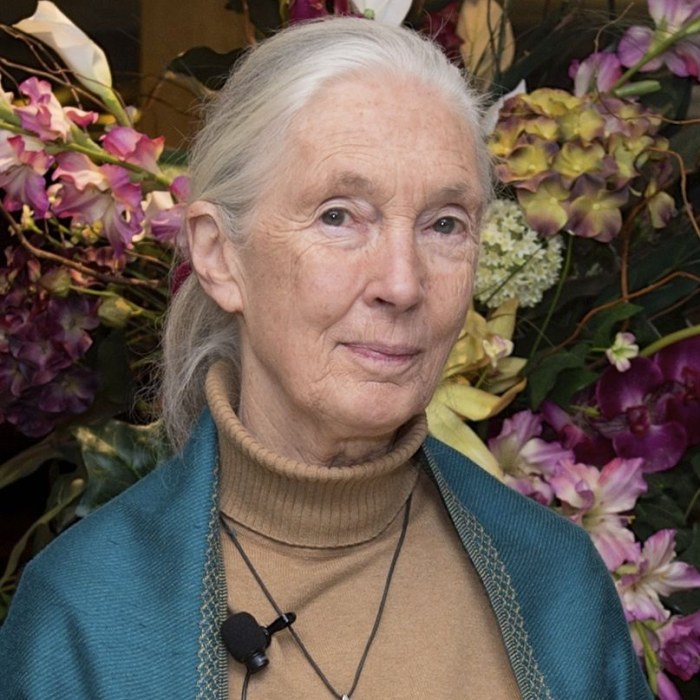
Jane Goodall
A secretary with no degree who changed what we know about chimpanzees, and about ourselves
Jane Goodall was born in London in 1934 and grew up in Bournemouth, where her mother encouraged an interest in animals that began with a toy chimpanzee and hours spent in a henhouse waiting to see how a hen laid an egg. The family could not afford university. She went to secretarial college and worked as a waitress to save the fare when a school friend invited her to Kenya in 1957.
There she talked her way into a job with the palaeontologist Louis Leakey, who believed that studying living great apes might illuminate early humans, and who thought an untrained mind would see things a trained one would miss. In July 1960 he sent her to Gombe Stream in Tanganyika to watch chimpanzees. The authorities would not allow a young woman to go alone, so her mother came too. For months the animals fled at the sight of her.
Then, in October, she watched a chimpanzee she had named David Greybeard strip the leaves from a twig and poke it into a termite mound to fish for insects. Tool-making had been the defining line between humans and other animals. Leakey wrote back that they would now have to redefine tool, redefine man, or accept chimpanzees as human. She went on to record hunting, warfare and grief among chimpanzees, and to take a Cambridge doctorate without ever having had a first degree.
From the 1980s she left fieldwork for advocacy, travelling around 300 days a year to speak on conservation. She died in October 2025, aged 91, on a speaking tour in California.