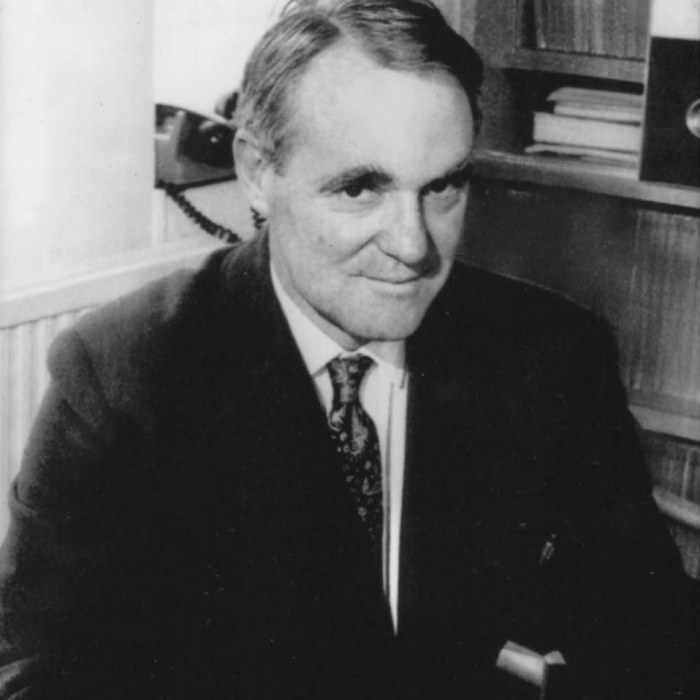
John Cornforth
Totally deaf by 20, he could not attend a lecture or use a telephone, and won the Nobel Prize in Chemistry
John Cornforth was born in Sydney in 1917. At about ten his hearing began to go, from a disease of the inner ear, and by the time he was 20 it had gone completely. He chose chemistry, he said, partly because it was something he could learn from books and practise with his hands, and at Sydney University he read his way through the lectures he could not hear.
There he met Rita Harradence, a fellow chemistry student, who had once broken a piece of glassware and been told to take it to the young man who could mend it. They both won scholarships to Oxford in 1939, and married there in 1941. For the rest of his life she was his interpreter as well as his collaborator, taking notes at seminars and relaying conversations.
During the war he worked on penicillin, helping to establish its structure. Afterwards he spent years at the Medical Research Council and then at a Shell laboratory, on a problem that suited a mind that liked working things out on paper: how enzymes handle molecules that are mirror images of each other. He and his group made molecules with carefully arranged hydrogen isotopes and used them to trace, step by step, the way the body builds cholesterol.
He shared the Nobel Prize in 1975. In his banquet speech he noted that he could not hear the applause. He worked at the University of Sussex into his nineties and died in 2013.