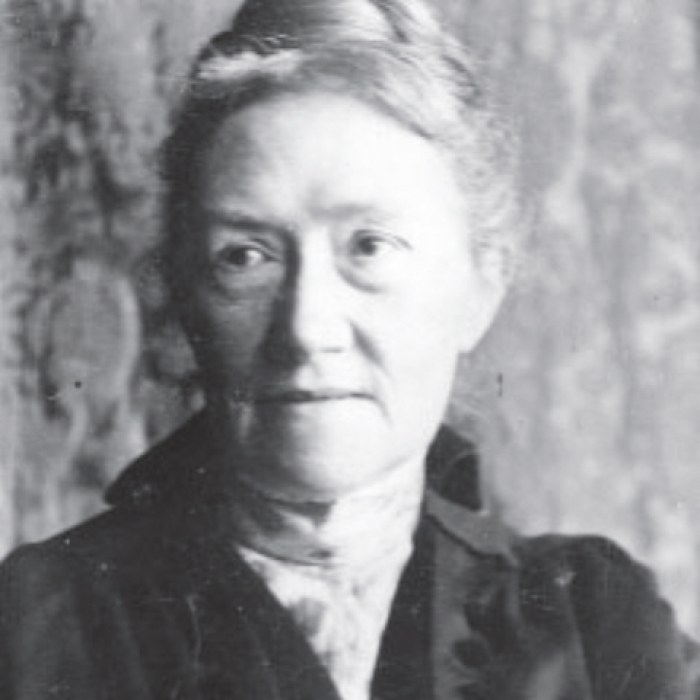
Agnes Pockels
Barred from university, she founded surface chemistry with a tin trough and a button in her kitchen
Agnes Pockels was born in Venice in 1862, where her father was serving in the Austrian army, and grew up in Braunschweig in northern Germany. She wanted to study physics. German universities did not admit women, and her parents were chronically ill, so from her late teens she stayed at home to nurse them and run the household. Her younger brother Friedrich went to Göttingen to study physics, and passed his textbooks on to her.
Her laboratory was the kitchen sink. She noticed the way oily films on water changed its surface, and around 1881, aged 19, she built an instrument to measure it: a long tin trough filled to the brim, a movable strip to sweep the surface, and a small button hung from a balance to measure the force needed to pull it free of the water. With this she could vary the area of a film and measure the surface tension, and she found that the tension dropped sharply once the film was compressed past a certain point.
In 1891 she wrote a letter, in German, to Lord Rayleigh, whose published work touched on the same questions. He had it translated and sent to Nature with a note saying it deserved publication, and it appeared that year. Her trough, refined by Irving Langmuir, became a standard tool; his Nobel Prize in 1932 rested partly on her method.
She never held a post. Braunschweig gave her an honorary doctorate in 1932, and she died in 1935.