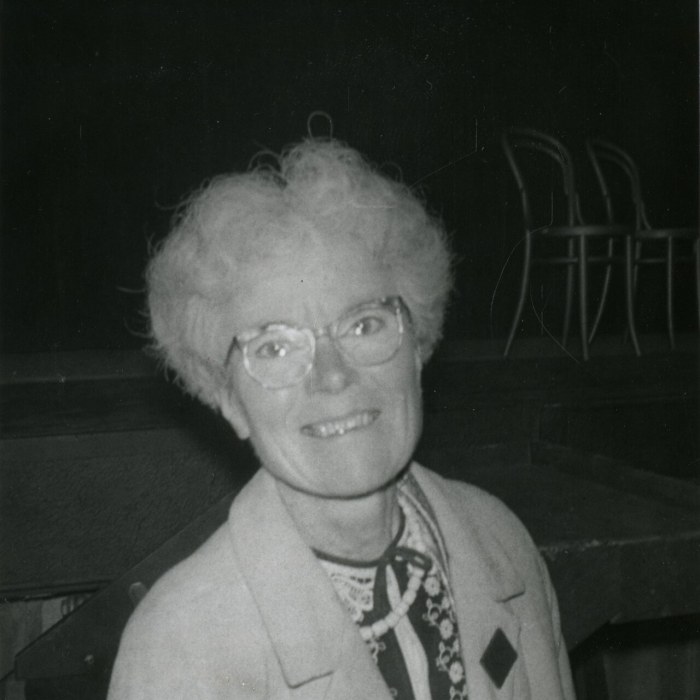
Kathleen Lonsdale
Went to prison for her beliefs and became one of the first two women elected to the Royal Society
Kathleen Yardley was born in 1903 in Newbridge, County Kildare, the tenth child of a village postmaster who drank. The family moved to England when she was five and her mother raised the children largely alone. She won scholarships all the way, and at 16 had to attend the boys' school for physics and chemistry because the girls' school did not teach them.
She took her degree at Bedford College, London, coming top of the university's physics list in 1922. One of her examiners was William Bragg, the pioneer of X-ray crystallography, who invited her to join his research group. There she learned to use X-rays to work out how atoms are arranged in crystals.
She married in 1927 and had three children. Bragg, unusually for the time, arranged a grant so she could keep working from home. In 1929, doing the calculations on her kitchen table, she showed that the benzene ring is flat, settling an argument that had run for decades in chemistry. She later used a hand-cranked calculator so heavy she had to sit on the floor to work it.
As a Quaker she refused to register for civil defence duties in the Second World War, and rather than pay the fine spent a month in Holloway prison in 1943, an experience that made her a lifelong campaigner for prison reform. In 1945 she and Marjory Stephenson became the first women elected Fellows of the Royal Society. She became the first woman professor at University College London and the first woman president of the British Association. She died in 1971.