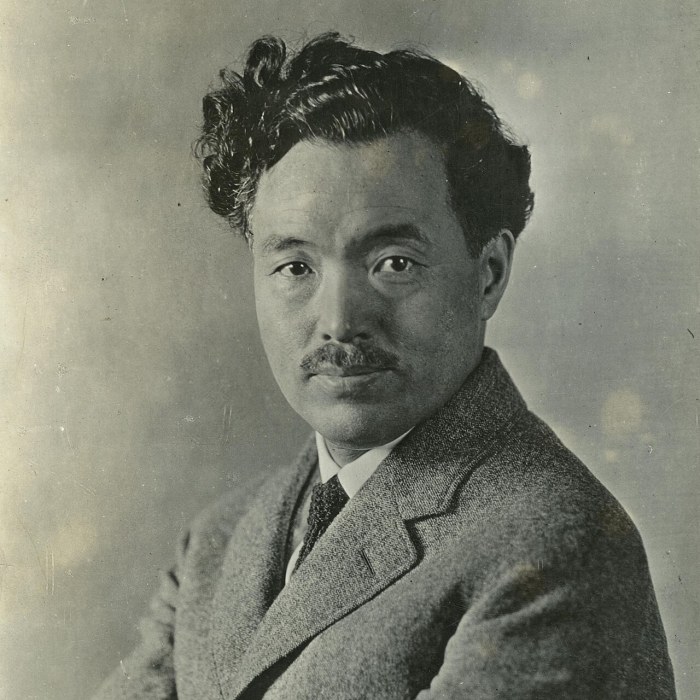
Hideyo Noguchi
A farm boy with a burned hand who chased the causes of disease from Japan to West Africa, and died there
Hideyo Noguchi was born in 1876 in Inawashiro, a village in Fukushima, to a poor farming family. Before he was two he fell into the open hearth and burned his left hand so badly that the fingers fused. Farm work was closed to him, and other children called him names. A teacher and classmates raised money for an operation when he was a teenager, and the surgeon who restored some movement to the hand became the person he wanted to be.
He qualified in medicine and, in 1900, sailed to the United States with almost nothing, talking his way into a post with the pathologist Simon Flexner in Philadelphia. He worked without stopping, and followed Flexner to the new Rockefeller Institute in New York, where he became one of its stars. In 1913 he showed the spirochete of syphilis in the brains of patients who had died of general paralysis, proving that the madness of late syphilis was the same disease. It was a real and lasting discovery.
Some of his other claims did not hold up. He said he had grown the syphilis organism in pure culture, and later that he had found the cause of yellow fever; neither result could be repeated, and the yellow fever work was wrong. In 1927 he went to Accra to settle the question, and in 1928 he died of yellow fever there, aged 51.
His portrait was on the Japanese thousand-yen note for two decades.