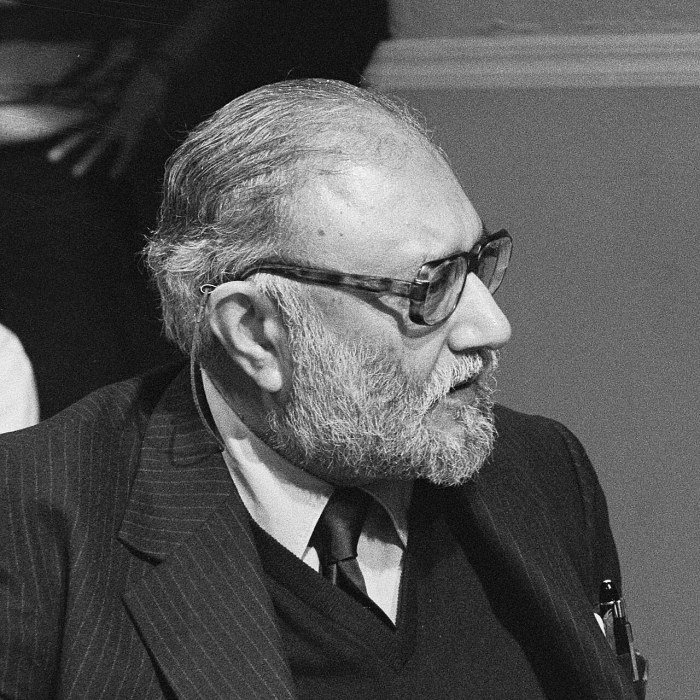
Abdus Salam
The first Muslim Nobel laureate in science, disowned by the country he never stopped serving
Abdus Salam was born in 1926 in Jhang, a small town in the Punjab, where his father was a clerk in the education department. At 14 he scored the highest marks ever recorded in the matriculation examination of Punjab University, and the whole town turned out to greet him when he cycled home. A scholarship took him to Government College, Lahore, and then in 1946 to Cambridge, where he completed a doctorate in theoretical physics.
He went home to teach in Lahore in 1951, and found himself alone. There were no journals, no colleagues in his field, and no one who could follow his work; he was asked instead to run the college football team. He faced a choice between physics and his country, and in 1954 chose to leave, returning first to Cambridge and then to Imperial College London.
He never let go of the problem. In 1964 he founded the International Centre for Theoretical Physics in Trieste, so that scientists from developing countries could keep in touch with the front line of research without emigrating. His own research, showing that the electromagnetic force and the weak nuclear force were two faces of one thing, brought him the 1979 Nobel Prize in Physics, shared with Sheldon Glashow and Steven Weinberg.
He belonged to the Ahmadi community, which Pakistan's parliament declared non-Muslim in 1974. He left the government post he had held for years in protest, though he kept advising the country. He died in Oxford in 1996 and was buried in Pakistan. Officials later had the word "Muslim" removed from his gravestone.