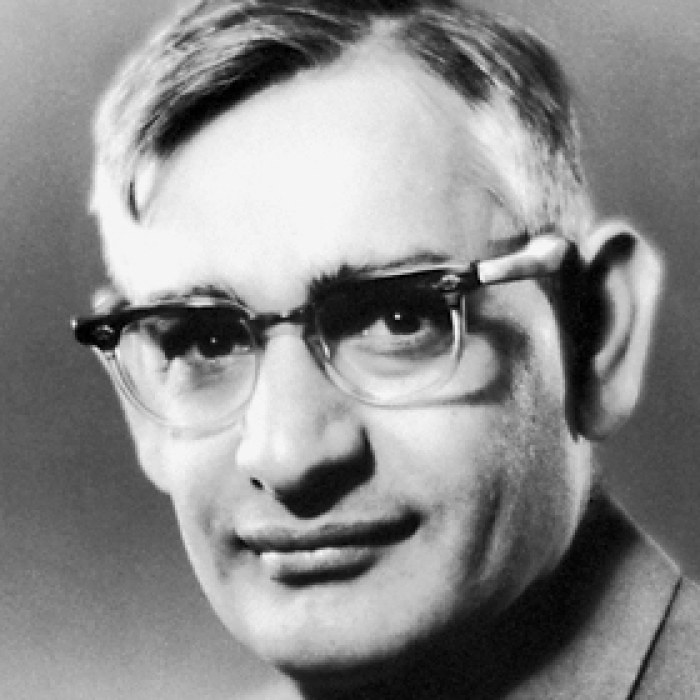
Har Gobind Khorana
From a village with one literate family to the man who helped crack the genetic code
Har Gobind Khorana was born in 1922 in Raipur, a village of about a hundred people in the Punjab, now in Pakistan. His father was a village clerk, and the family was, he later said, practically the only literate one there. His early lessons took place outdoors. He walked to school in the next town, won scholarships to the University of the Punjab in Lahore, and in 1945 a government scholarship sent him to Liverpool for a doctorate in chemistry.
For years he had no settled position. He worked in Zurich without pay, then in Cambridge, and in 1952 took a job in Vancouver at a research council that offered him little money but freedom. There he worked out how to make the small energy-carrying molecules of the cell, and began to think about DNA.
At the University of Wisconsin in the 1960s he set out to settle exactly how the sequence of a gene is read. Others had shown that three bases code for one amino acid; Khorana synthesised DNA and RNA of known repeating sequence and used them to work out, letter by letter, which triplets meant what. It was slow chemistry, thousands of steps, done by a large team he ran with quiet intensity. The Nobel Prize came in 1968. Two years later his group made the first fully synthetic gene.
He moved to MIT in 1970 and worked there for over thirty years, avoiding publicity and rarely returning to India. He died in 2011.