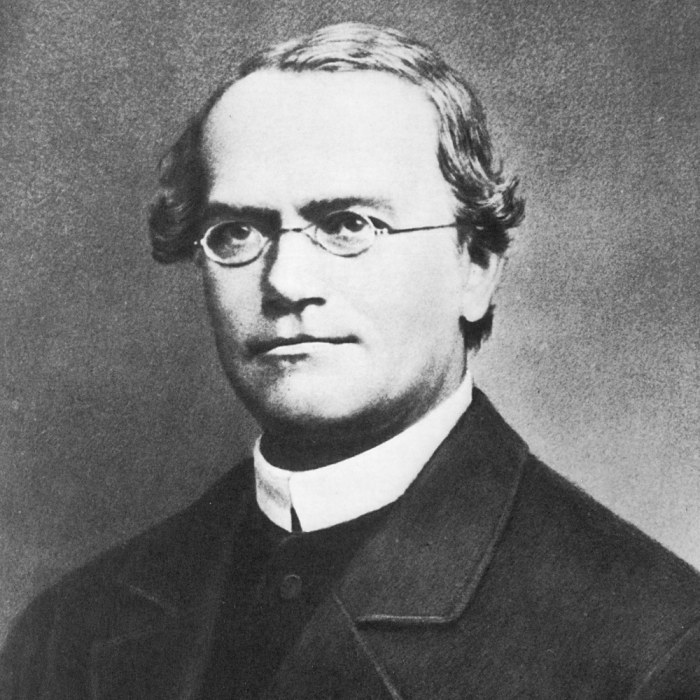
Gregor Mendel
Failed his teaching exams twice, counted 28,000 pea plants and founded genetics without anyone noticing
Johann Mendel was born in 1822 in a village in Silesia, now in the Czech Republic, where his family had farmed the same land for generations. He was clever enough to be sent away to school, which the family could barely afford; he went hungry, fell ill more than once, and his younger sister gave up part of her dowry to keep him there. At 21, unable to pay for university, he entered the Augustinian abbey in Brno and took the name Gregor.
The abbey wanted him to teach, but he was so nervous at the bedside of the sick and in the examination hall that he failed the state teaching certificate in 1850. The abbot sent him to the University of Vienna to study physics and natural science. He failed the exam a second time in 1856, apparently after some kind of breakdown, and spent his career as an unqualified substitute teacher.
By then he had begun his experiments. Between 1856 and 1863 he grew and crossbred around 28,000 pea plants in the abbey garden, tracking traits such as height, colour and seed shape through generations. He found they were passed on in fixed ratios by discrete factors that did not blend, what we now call genes. He presented the results in 1865 and published them the next year in the local natural history society's journal.
Almost nobody read it. He was elected abbot in 1868 and was consumed by administration and a long tax dispute with the government. He died in 1884. In 1900 three botanists independently rediscovered his laws, and found that a monk had beaten them by 35 years.