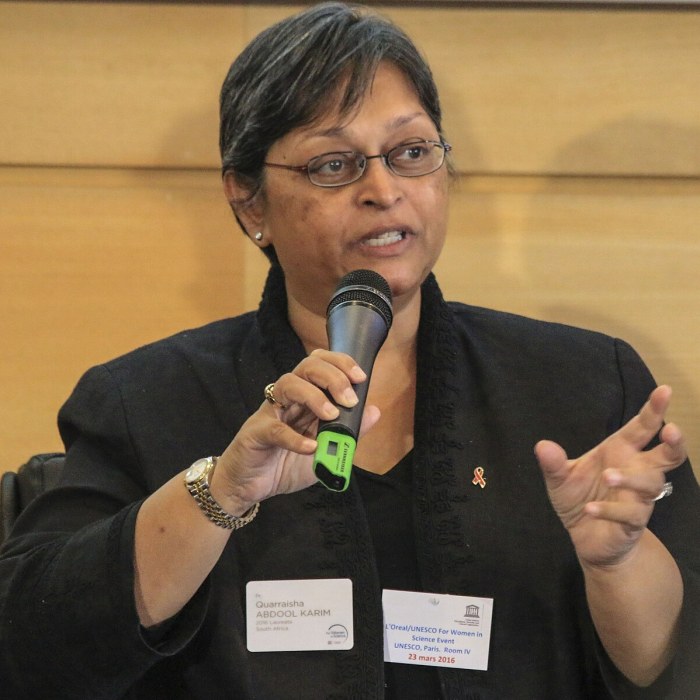
Quarraisha Abdool Karim
Proved that women could protect themselves from HIV, after twenty years of trials that did not work
Quarraisha Abdool Karim was born in 1960 in Tongaat, a sugar-mill town north of Durban, into a family of Indian descent living under apartheid. She trained as a biochemist and then in epidemiology, and in the late 1980s, when HIV was still thought of as a disease of gay men in rich countries, she began looking at what was happening in rural KwaZulu-Natal.
What she found, in a 1992 survey, was that teenage girls and young women were being infected at several times the rate of young men. The reasons were not mainly biological. Women often could not insist on condoms, and could not leave relationships on which they depended. Any prevention method that required a man's cooperation was going to fail for exactly the people who needed it most.
The obvious answer was a product a woman could use herself. Finding one took most of her working life. Trial after trial of microbicide gels, through the 1990s and 2000s, showed nothing or made things worse. In 2010 the CAPRISA 004 trial, which she led with her husband Salim, showed that a gel containing the antiretroviral tenofovir cut infections by roughly two fifths. It was the first proof that antiretroviral drugs could prevent HIV in women, and it opened the way to the prevention pills and injections now used around the world.
She has since led further work on adolescent girls, mentored a generation of African scientists, and won the Canada Gairdner Global Health Award in 2020.