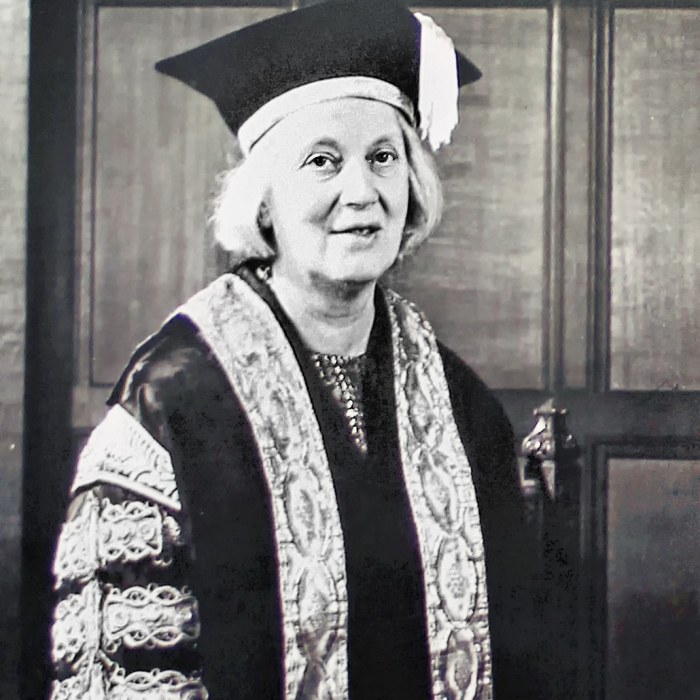
Dorothy Hodgkin
Mapped penicillin, vitamin B12 and insulin with hands crippled by arthritis
Dorothy Crowfoot was born in Cairo in 1910, the daughter of a colonial education officer, and spent much of her childhood in England separated from her parents by the First World War. At ten she was given a chemistry set and started growing crystals. At Somerville College, Oxford, she was one of a handful of women reading chemistry, and she went on to Cambridge to learn X-ray crystallography, a technique then in its infancy.
In 1934, aged 24, she was diagnosed with rheumatoid arthritis. Her hands and feet became swollen and deformed, and the pain never fully left her. She was returning to Oxford to set up her own laboratory in a damp basement of the university museum, with almost no money and equipment she had to beg for.
The work she chose was slow and often thankless. Working out a molecule's structure from the spots on an X-ray photograph meant months of calculation by hand. She solved penicillin in 1945, which helped chemists make it in bulk, and vitamin B12 in 1955, a molecule so large that many thought it impossible. Insulin took her 35 years: she first photographed it in 1934 and published the structure in 1969.
She won the Nobel Prize in Chemistry in 1964. A newspaper headline read "Oxford housewife wins Nobel". She raised three children, campaigned against nuclear weapons for decades, and taught a chemistry student named Margaret Roberts, later Margaret Thatcher, who kept a portrait of her in Downing Street. She died in 1994.