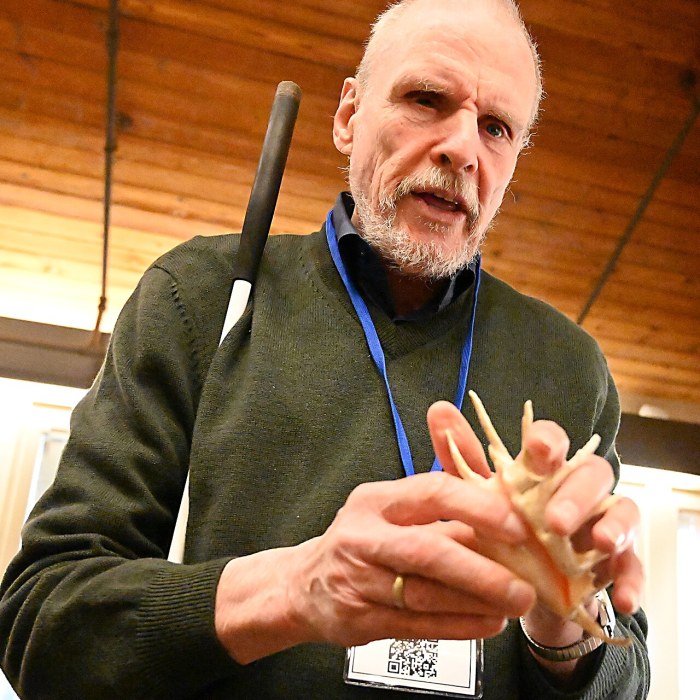
Geerat Vermeij
Blind from the age of three, he reads the history of life in the shapes of seashells by touch
Geerat Vermeij was born in the Netherlands in 1946 and lost his sight to glaucoma at three. His parents were told to prepare him for a sheltered life. Instead, when he was nine, they emigrated to New Jersey so that he could attend ordinary schools, and a teacher there put shells from Florida on the windowsill and let him handle them. He was struck by how smooth and elaborate they were compared to the ones he knew from Dutch beaches, and wanted to know why.
He learned to read with his hands and went to Princeton, where the biology department was doubtful about a blind student and accepted him anyway. He did his doctorate at Yale, working with specimens he could handle rather than diagrams he could not, and in the field, wading along tropical shorelines.
His fingers turned out to be an advantage. Feeling a shell, he registered its thickness, the tightness of its coiling and the marks left by predators in a way that eyes tend to skip over. From thousands of such observations he argued that over hundreds of millions of years, shells have grown thicker and more heavily armoured in response to the claws and jaws of their predators, and that this escalation between hunter and hunted is one of the main engines of evolution.
He has been a professor at the University of California, Davis, since 1989, won a MacArthur fellowship in 1992, and described his life in a memoir called Privileged Hands.