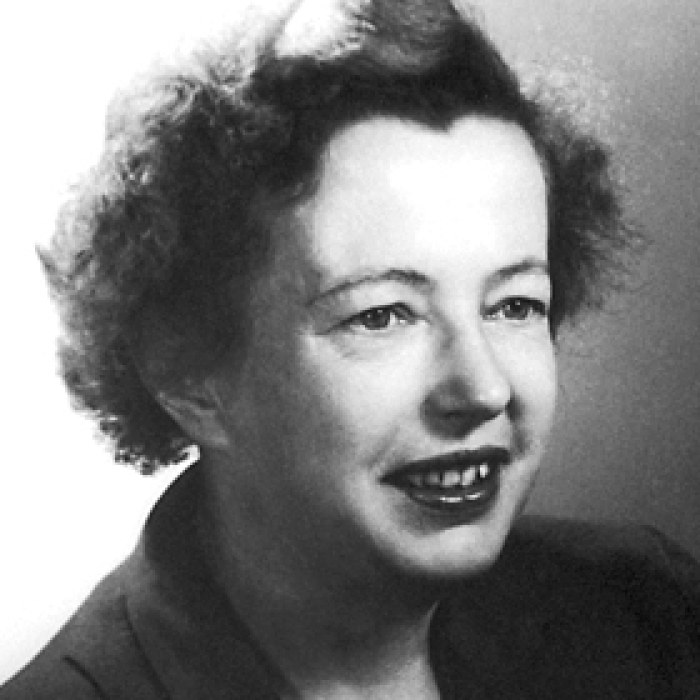
Maria Goeppert Mayer
Worked unpaid for nearly thirty years, then won the Nobel Prize for explaining how the nucleus is built
Maria Goeppert was born in 1906 in Kattowitz, then in Germany, and grew up in Göttingen, where her father was a professor of paediatrics and expected her to be more than a housewife. She studied mathematics and then physics there in the great years of quantum mechanics, with Max Born as her supervisor, and completed a doctorate in 1930 that Wigner later called a masterpiece.
That year she married the American chemist Joseph Mayer and moved to Baltimore. Johns Hopkins would not hire the wife of a faculty member, so she was given a desk, a small allowance and no title. The same thing happened at Columbia, and again at Chicago. For most of her working life she had no salary and no proper position, and did her physics anyway, at home and in borrowed offices, while raising two children. During the war she worked on isotope separation.
In the late 1940s, at Chicago and the Argonne laboratory, she puzzled over why certain numbers of protons or neutrons made a nucleus unusually stable. Her answer was that nucleons occupy shells inside the nucleus, much as electrons do around it, with their spin and orbit coupled. Hans Jensen in Germany reached the same conclusion independently, and they wrote a book together.
In 1960 the University of California at San Diego gave her a full professorship, her first paid post. In 1963 she shared the Nobel Prize in Physics. A local newspaper reported it as a San Diego mother winning. She died in 1972.