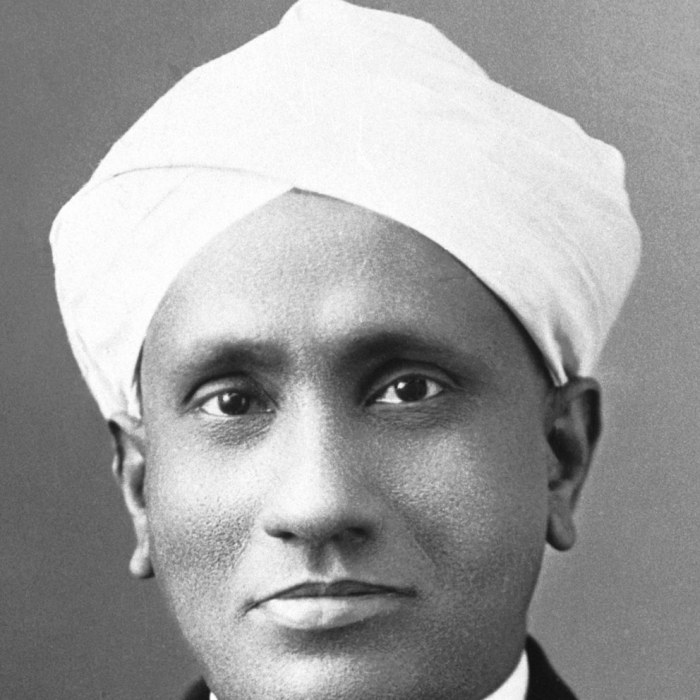
C. V. Raman
Noticed the sea was too blue to be explained by reflected sky, and won a Nobel Prize finding out why
Chandrasekhara Venkata Raman was born in 1888 in Tiruchirappalli, in what was then British India, to a family of modest means and academic inclination. He excelled early, finishing his degree at Presidency College, Madras, at 16, but a career in physics research was not considered a realistic option for an Indian at the time, so he took a job in the Indian civil service in Calcutta instead.
He kept doing physics in whatever hours he could find, working evenings and weekends at the Indian Association for the Cultivation of Science, a body run largely on donations. In 1921, sailing back from England, he grew curious about why the sea appeared blue even in conditions that could not be explained by the sky's reflection. Pursuing the question over the following years, he and his student K. S. Krishnan found that light passing through a transparent substance sometimes changes wavelength, a phenomenon that came to be called the Raman effect.
The discovery gave scientists a new way to study the molecular structure of materials by analysing how they scattered light, and it earned Raman the 1930 Nobel Prize in Physics, the first awarded to any scientist working in Asia.
He went on to found the Raman Research Institute in Bangalore, where he continued working until shortly before his death in 1970, and remained a fierce advocate for Indian-led scientific research.