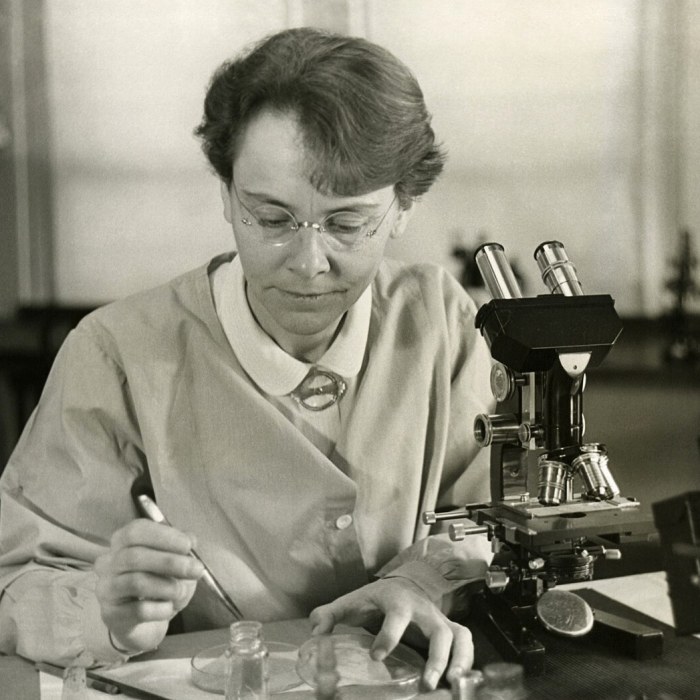
Barbara McClintock
Discovered that genes can move, and waited thirty years for anyone to believe her
Barbara McClintock grew up in Brooklyn, a solitary, stubborn child whose mother worried that a college education would make her unmarriageable. Her father overruled the objection, and she went to Cornell, where women were not allowed to major in genetics. She studied it anyway through the botany department and by the late 1920s was doing work on maize chromosomes that put her at the front of the field.
There was still no proper job for her. Universities did not hire women as faculty, so she moved between fellowships and temporary posts for over a decade. In 1941 she found a permanent home at Cold Spring Harbor Laboratory on Long Island, where she could grow her corn and be left alone.
It was there, tracking the colour patterns of kernels across generations, that she worked out something nobody expected: certain genetic elements could move from one place on a chromosome to another, switching other genes on and off as they went. When she presented the idea at a symposium in 1951 the response was silence, then puzzlement, then dismissal. The consensus was that genes were fixed beads on a string. She stopped publishing on the subject a few years later rather than keep arguing.
She never stopped working. Molecular biologists found the same "jumping genes" in bacteria in the late 1960s and 1970s, and it slowly became clear she had been right all along. In 1983, at 81, she was awarded the Nobel Prize in Physiology or Medicine, the first woman to win it alone.