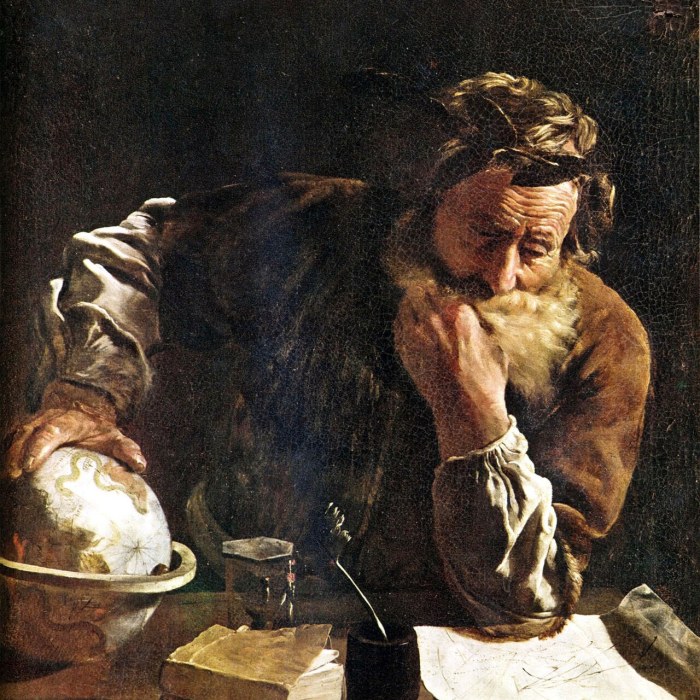
Archimedes
The greatest mathematician of antiquity, killed by a soldier while working on a problem
Archimedes was born around 287 BC in Syracuse, a Greek city on Sicily, the son of an astronomer. He probably studied in Alexandria, then the intellectual centre of the Mediterranean, and kept up a correspondence with its mathematicians all his life. Almost everything else about his life comes from stories written down long after his death.
The famous ones, the bath and the shout of "Eureka", the boast that he could move the Earth with a long enough lever, may or may not be true. His surviving writings are better evidence. He proved that the area of a circle equals that of a triangle with its radius for height and its circumference for base, and squeezed the value of pi between narrow bounds. He explained why objects float, and worked out the volume of a sphere, a result he asked to have carved on his tomb. In a work called The Method he explained how he had used physical reasoning about balance to guess results before proving them, a rare glimpse of a great mind at work.
When the Romans besieged Syracuse, his catapults and cranes held them off for two years. When the city fell, around 212 BC, a soldier killed him, according to one account because he refused to leave a diagram he was drawing. The Roman commander had wanted him alive.
Most of his works were lost. In 1906 a scholar found The Method beneath the text of a medieval prayer book, whose maker had scraped the parchment clean and written over it. It was read fully only in the twenty-first century.