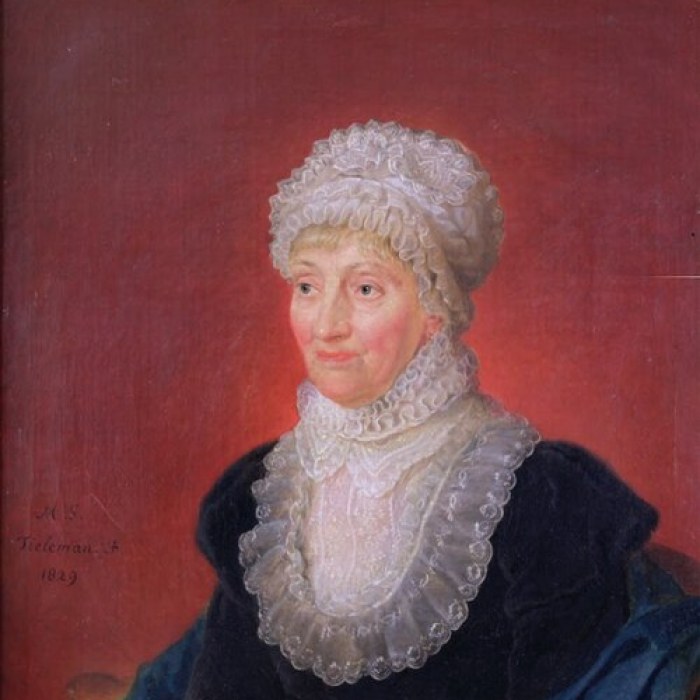
Caroline Herschel
Raised as a household drudge, she became the first woman paid to do science
Caroline Herschel was born in Hanover in 1750, the eighth child of a military musician. Typhus at ten left her permanently small, about four foot three, and her parents decided she would never marry. Her mother saw no point in educating her and put her to work at housework and sewing. Her father taught her a little music in secret.
In 1772 her brother William, who had settled in Bath as a musician, brought her to England to keep house and sing in his concerts. She became a capable soprano. But William was increasingly obsessed with building telescopes and studying the sky, and she was drawn in: first grinding mirrors and feeding him while he polished for hours on end, then recording his observations through the night, then making her own.
After William discovered Uranus in 1781 and became the King's astronomer, she was given a small telescope for sweeping the sky. Between 1786 and 1797 she found eight comets, the first ever attributed to a woman. In 1787 George III granted her a salary of fifty pounds a year as William's assistant. It was the first time in Britain a woman had been paid for scientific work. She also reworked and corrected the standard star catalogue, adding hundreds of stars that had been missed.
After William's death in 1822 she returned to Hanover, where she organised his observations of nebulae into a catalogue that earned her the Royal Astronomical Society's gold medal in 1828. She was made an honorary member in 1835. She died in 1848, aged 97.