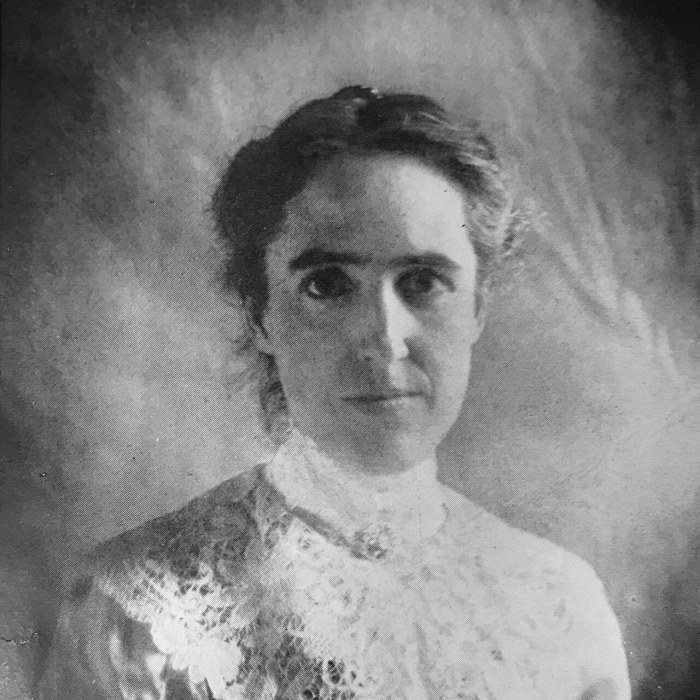
Henrietta Swan Leavitt
A deaf, underpaid "computer" who gave astronomers a ruler for the universe
Henrietta Leavitt was born in Massachusetts in 1868, the daughter of a Congregational minister. She studied at the college that became Radcliffe, taking an astronomy course in her final year. Shortly after graduating she fell seriously ill, and the illness left her progressively deaf for the rest of her life.
In 1895 she began volunteering at the Harvard College Observatory, one of a group of women, known as "computers", who examined photographic plates and recorded the positions and brightness of stars. The director, Edward Pickering, hired women because they were careful and cheap. Leavitt was eventually paid thirty cents an hour and given the task of finding variable stars, those whose brightness changes over time. She found more than 2,400 of them.
Among them was a class called Cepheids in the Small Magellanic Cloud. Because all these stars were roughly the same distance from Earth, she could compare them fairly, and she noticed that the brighter ones took longer to pulse. In 1912 she published the relationship in three pages. It meant that if you timed a Cepheid's pulse, you knew its true brightness, and from that how far away it was.
It was the first reliable way to measure distances beyond our galaxy. Edwin Hubble used it to show that Andromeda was a separate galaxy and that the universe was expanding. Leavitt, meanwhile, was given other routine assignments. She died of cancer in 1921, aged 53. Four years later a Swedish mathematician wrote to nominate her for a Nobel Prize, not knowing she was dead.