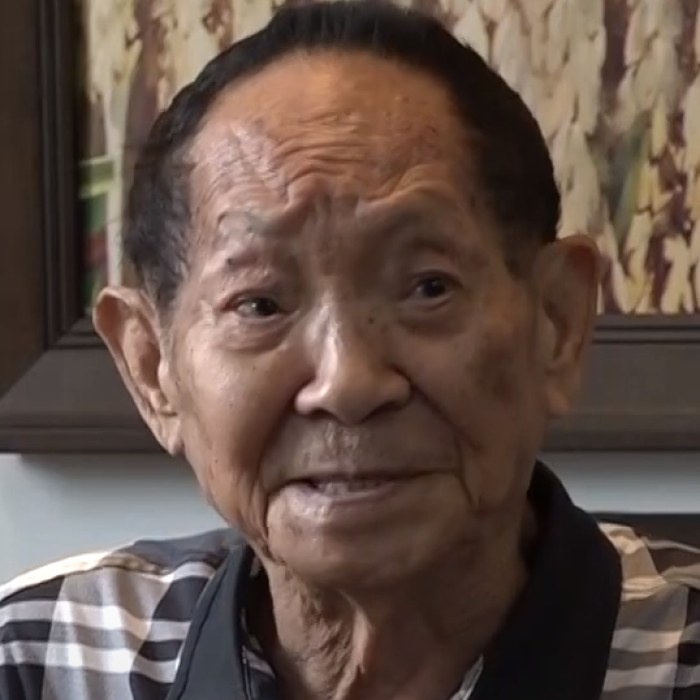
Yuan Longping
Saw people starve in the famine and spent the next sixty years making rice yield more
Yuan Longping was born in Beijing in 1930 and grew up moving around China ahead of the Japanese army. He studied agronomy in Chongqing and in 1953 was sent to teach at an agricultural school in Anjiang, a small town in Hunan. It was not a prestigious posting. He stayed for nearly twenty years.
The famine of 1959 to 1961 killed tens of millions. He saw bodies by the roadside and people eating bark, and he later said that this was when he decided what his work would be. The orthodox science of the time, borrowed from the Soviet Union, held that rice could not be hybridised because it fertilised itself. In 1961 he found a single plant in a field that was clearly a natural hybrid, taller and heavier than its neighbours, and reasoned that if nature could do it, so could he.
Progress took a decade of failure. During the Cultural Revolution his experimental pots were destroyed; he found a few survivors in a well and carried on. The breakthrough came in 1970, when an assistant found a wild male-sterile rice plant in a ditch on Hainan island. It was the missing parent. By 1973 he had a working hybrid, and by 1976 it was being planted across China with yields about a fifth higher than ordinary varieties.
He spent the rest of his life pushing the yield up further and training breeders abroad. He won the World Food Prize in 2004 and died in Changsha in 2021, aged 90. Crowds lined the streets.