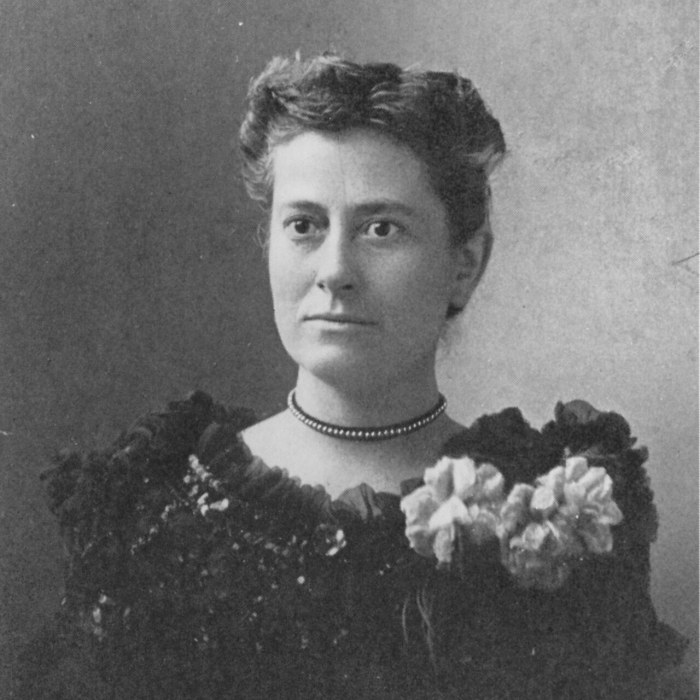
Williamina Fleming
Abandoned while pregnant and working as a maid, she went on to classify ten thousand stars
Williamina Stevens was born in Dundee in 1857 and was a pupil-teacher from the age of 14. She married James Fleming and emigrated with him to Boston in 1878. Within a year, with her pregnant, he had left. She took the only work she could find, as a maid in the house of Edward Pickering, the director of the Harvard College Observatory.
Pickering, exasperated by a male assistant, is said to have declared that his housekeeper could do better. Whether or not he put it that way, in 1881 he took her on at the observatory to do clerical and computing work. The observatory was building a huge collection of photographic plates on which the spectrum of each star appeared as a small smear of light, and someone had to examine and sort them. Fleming devised a classification scheme based on the strength of the hydrogen lines, and in 1890 the first Draper Catalogue was published with more than 10,000 stars classified by her.
She went on to find 59 gaseous nebulae, over 300 variable stars and ten novae; the plate on which the Horsehead Nebula was first recorded, in 1888, was hers. She also supervised the growing team of women computers. Her diary records her irritation at being paid a fraction of what the men earned for work that was, in her view, at least as good.
In 1899 Harvard gave her a formal title, the first for a woman there. The Royal Astronomical Society made her an honorary member in 1906. She died of pneumonia in 1911.