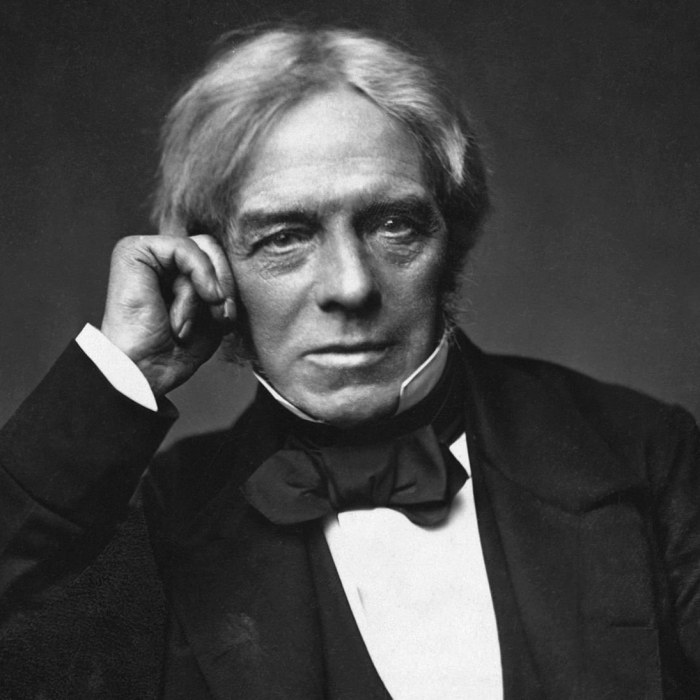
Michael Faraday
A blacksmith's son with no schooling who read the books he was binding and discovered electromagnetism
Michael Faraday was born in 1791 in south London, the son of a blacksmith too ill to work regularly. The family lived on parish relief at times; he later recalled being given one loaf to last a week. His education was reading, writing and a little arithmetic. At 14 he was apprenticed to a bookbinder, and he read the books that came through the shop, including the entry on electricity in the Encyclopaedia Britannica and a popular chemistry book written for girls by Jane Marcet.
In 1812 a customer gave him tickets to hear Humphry Davy lecture at the Royal Institution. Faraday took notes, bound them into a 300-page book and sent it to Davy asking for a job. When a laboratory assistant was sacked for fighting, Davy took him on. On a tour of Europe Davy's wife treated him as a servant, and he nearly gave up.
He did not. In 1821 he made a wire rotate around a magnet, the first electric motor. In 1831 he showed that a moving magnet produces a current, which is the principle behind every generator and transformer in the world. He was weak at mathematics all his life, and reasoned instead with pictures of lines of force that Maxwell later turned into equations.
A devout member of a tiny Christian sect, he refused a knighthood, twice refused the presidency of the Royal Society, and declined to advise the government on poison gas for the Crimean War. He started the Royal Institution's Christmas Lectures for children, which continue today. His memory failed in his last years, and he died in 1867.