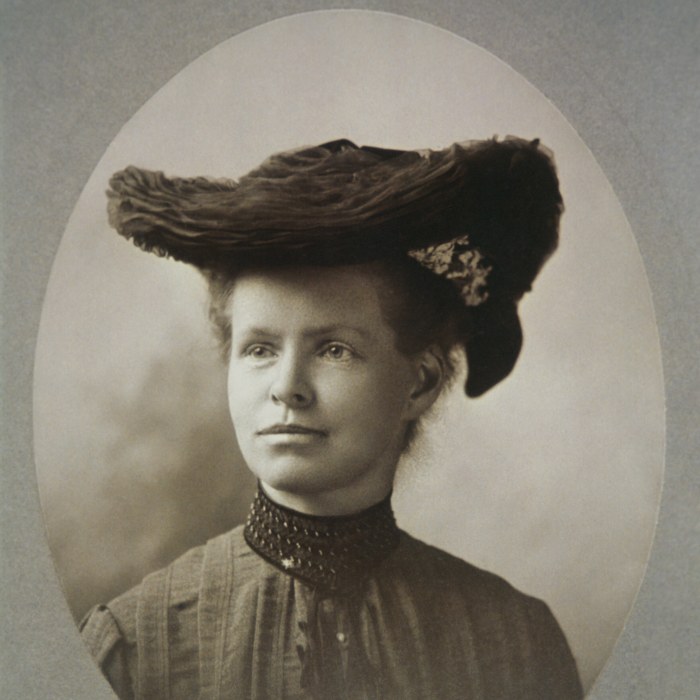
Nettie Stevens
A schoolteacher who started her doctorate at 39 and discovered how sex is determined, in a mealworm
Nettie Stevens was born in Vermont in 1861, the daughter of a carpenter. She was a fine student, and there was no money for more school. She taught for years in Massachusetts, teaching Latin, English, mathematics and physiology, and saved. In 1896, at 35, she had enough to go to Stanford, where she took a bachelor's and then a master's degree, and in 1900 she began a doctorate at Bryn Mawr College in Pennsylvania, one of the few places a woman could do one.
She completed it in 1903, with a year in Germany and Naples in between, and stayed on at Bryn Mawr on short research grants. The question she chose was one of the oldest in biology: what decides whether an animal is born male or female? Most people thought it was the environment, or food, or the mother.
In 1905, studying the mealworm beetle, she found that the sperm carried either a large chromosome or a small one, and that eggs fertilised by the small one produced males. Sex was inherited, on a chromosome. Edmund Wilson at Columbia published similar findings the same year, more cautiously, and for decades the discovery was credited to him. Her own paper was clearer and her conclusion stronger.
She published prolifically for the next seven years. Bryn Mawr finally created a research professorship for her in 1912, but she died of breast cancer that May before she could take it up, aged 50.