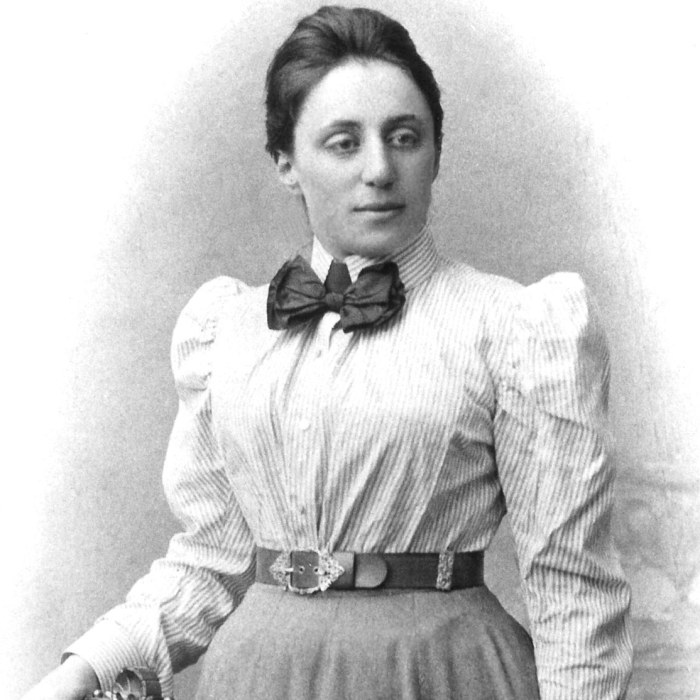
Emmy Noether
Taught for years without pay or title and proved a theorem at the heart of modern physics
Emmy Noether was born in Erlangen in 1882, the daughter of a mathematics professor. Women could not enrol at German universities, so she sat in on lectures with the individual permission of each professor, one of two women among nearly a thousand students. When the rules changed she completed a doctorate in 1907, then worked for seven years at the Erlangen mathematics institute without pay or position.
In 1915 David Hilbert and Felix Klein invited her to Göttingen, then the centre of the mathematical world. Other faculty objected to a woman lecturer; one asked what returning soldiers would think of learning at the feet of a woman. Hilbert replied that they were a university, not a bathhouse. She was allowed to teach only by advertising her courses under his name, and was not paid a salary until 1923.
That same year she proved the result now called Noether's theorem: every continuous symmetry in the laws of physics corresponds to a conserved quantity. It explains why energy and momentum are conserved and underpins the whole of modern theoretical physics. In pure mathematics she went further, largely creating the abstract algebra taught in universities today. She published generously, giving ideas away to students who became known as "Noether's boys".
In 1933 the Nazi government dismissed her as a Jew. She found refuge at Bryn Mawr College in Pennsylvania, and died there in 1935 after surgery, aged 53. Einstein wrote to the New York Times that she was the most significant creative mathematical genius produced since women had been admitted to higher education.