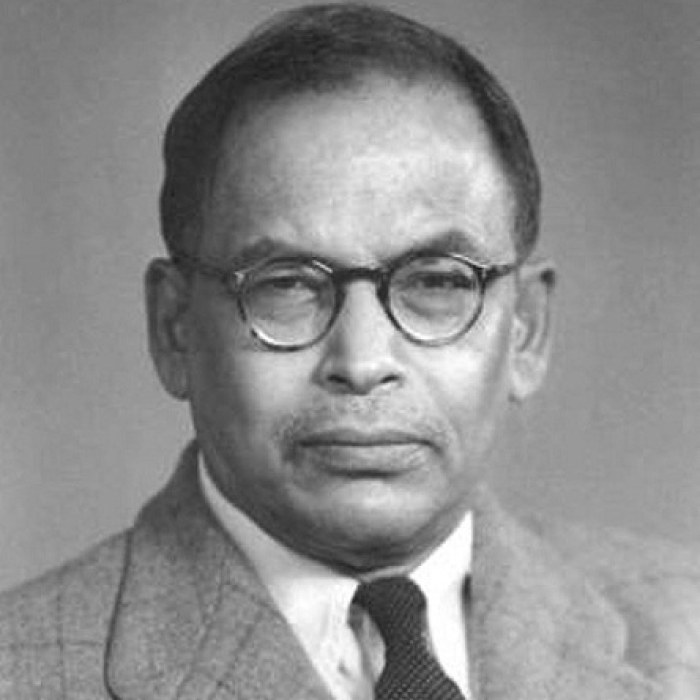
Meghnad Saha
A grocer's son from Bengal who worked out how to read the temperature of a star
Meghnad Saha was born in 1893 in a village near Dhaka, the fifth child of a small grocer. There was no money for schooling beyond the village; a local doctor paid for him to board and continue. He was a brilliant student and a stubborn one. In 1905, as a schoolboy, he joined a boycott of a visit by the governor of Bengal and was expelled, losing his scholarship. Later, at college in Calcutta, he was refused a place in the hostel because of his caste.
He studied under Jagadish Chandra Bose and Prafulla Chandra Ray, and taught himself the new physics coming out of Germany from books and papers that reached India months late. In 1920, working largely alone in Calcutta, he published the equation that carries his name. It describes how the atoms in a hot gas become ionised as the temperature rises, and it explained for the first time why stars of different temperatures show different lines in their spectra. Astronomers could now take a spectrum and infer what a star was made of and how hot it was.
The work was done with no proper laboratory and little encouragement. He was nominated for the Nobel Prize several times and never received it.
He spent the rest of his life building Indian science: a physics institute in Calcutta, a journal, plans for river control and calendar reform. He was elected to Parliament as an independent in 1952 and died in Delhi in 1956, on his way to a meeting.