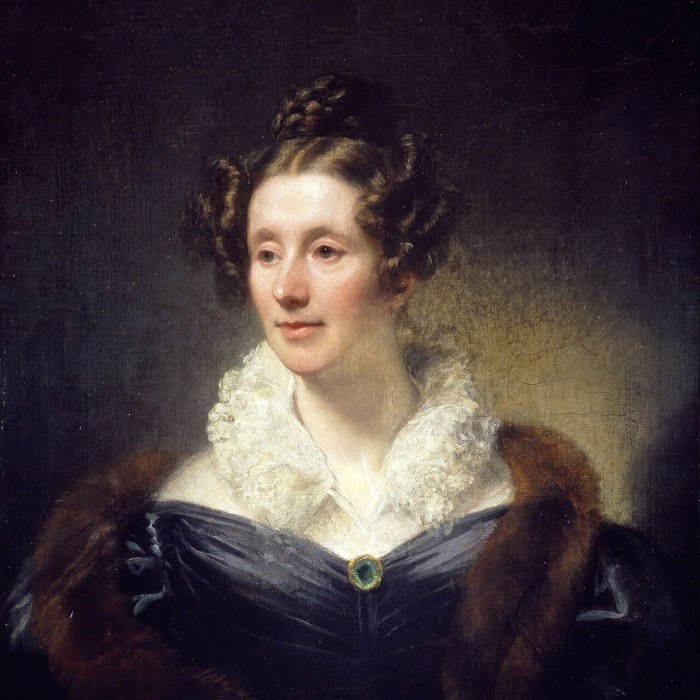
Mary Somerville
Taught herself algebra from a fashion magazine and became the woman the word "scientist" was coined for
Mary Fairfax was born in Jedburgh in 1780, the daughter of a naval officer, and grew up in Burntisland on the Firth of Forth. She had one year of formal schooling, at a boarding school she hated. At about 15 she came across an algebra puzzle in a ladies' fashion magazine and was hooked. Her father, when he found out, banned the study of mathematics, fearing it would send her mad, so she read Euclid by candlelight and had her brother's tutor buy her books.
Her first husband, a naval captain, disapproved of women's education. He died after three years, leaving her with two small children and, for the first time, money and freedom of her own. She learned Newton's mathematics and began solving problems in a mathematical journal. Her second husband, William Somerville, a doctor, was different: he encouraged her, copied out her manuscripts and introduced her to scientists in London.
In 1831, at 51, she published a translation and explanation of Laplace's monumental Celestial Mechanics, which few in Britain could follow. It became a Cambridge textbook. Her 1834 book On the Connexion of the Physical Sciences was so wide-ranging that the reviewer William Whewell, casting around for a word to describe someone who studied all these fields, proposed "scientist".
In 1835 she and Caroline Herschel became the first women elected honorary members of the Royal Astronomical Society. She kept writing into her nineties and died in Naples in 1872. Somerville College, Oxford, is named after her.