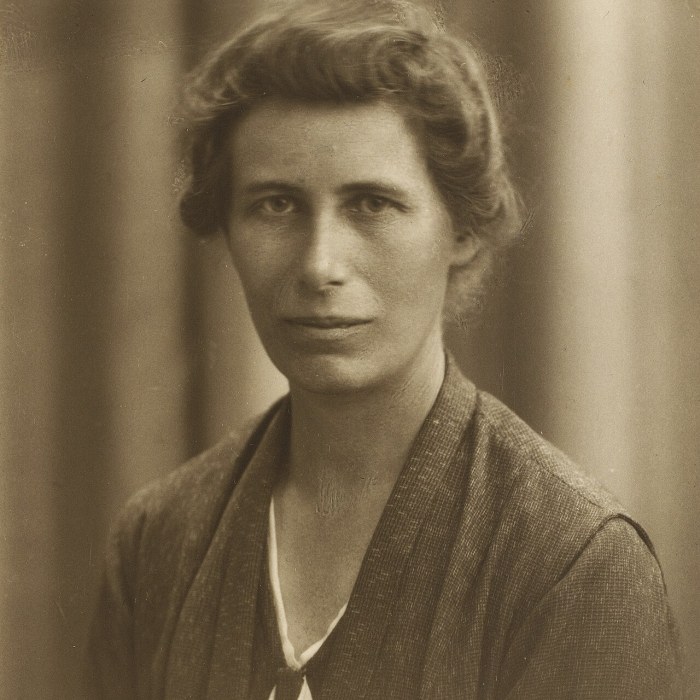
Inge Lehmann
Found the solid core at the centre of the Earth from paper records, and worked until she was over 100
Inge Lehmann was born in Copenhagen in 1888. She went to a progressive school run by Hanna Adler, the aunt of Niels Bohr, where boys and girls were taught the same subjects and played the same games, and she later said this left her unprepared for how the world treated women. She studied mathematics at Copenhagen and Cambridge, had a breakdown from overwork, and spent several years as an actuary.
In 1925 she took an assistant's job helping set up seismograph stations in Denmark and Greenland, and found her subject. By 1928 she was head of the seismology department of the Geodetic Institute, which in practice meant she was the seismology department, reading the instruments, publishing the bulletins and corresponding with observatories around the world.
Seismologists knew that the Earth had a liquid core, because certain waves from distant earthquakes did not pass through it. But some waves turned up in a shadow zone where the theory said they could not be. Lehmann collected records of large earthquakes in the Pacific, worked through the arrival times, and in a 1936 paper with the shortest title in the field, simply P', proposed that inside the liquid core lay a smaller solid one, which bent the waves back out. Other seismologists accepted it within a few years.
She retired in 1953 and only then had the freedom to do full-time research, in the United States and at home. She died in 1993, aged 104.