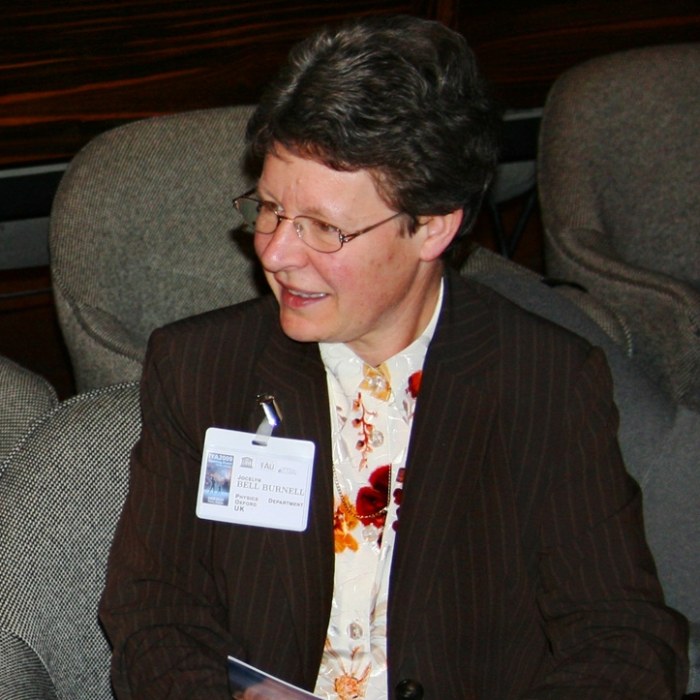
Jocelyn Bell Burnell
Discovered pulsars as a student and watched the Nobel Prize go to her supervisor
Jocelyn Bell grew up in Lurgan, Northern Ireland, in a Quaker family. At her school, girls were sent to the domestic science room while the boys did science, until her parents and others protested. She failed the eleven-plus exam and was sent to a boarding school in York, where a physics teacher convinced her she could do the subject.
At Glasgow University she was the only woman in her honours physics class, and the men stamped and whistled every time she walked into a lecture theatre. She went to Cambridge for her PhD, and spent her first two years there hammering posts and stringing wire to help build a radio telescope the size of several football pitches.
Her job was to analyse the output: around 30 metres of chart paper a day, read by eye. In late 1967 she noticed a small, regular blip that did not fit any known source. Her supervisor Antony Hewish thought it was interference. She kept looking and found more of them, pulsing with a precision no one had seen in nature. They were pulsars, rapidly spinning neutron stars, and their discovery opened a new field of astronomy.
The 1974 Nobel Prize in Physics went to Hewish and Martin Ryle. Bell Burnell, by then raising a child and working part-time, was not included, and has always said in public that she does not mind. In 2018 she was awarded the three-million-dollar Breakthrough Prize and donated all of it to fund physics students from underrepresented backgrounds.