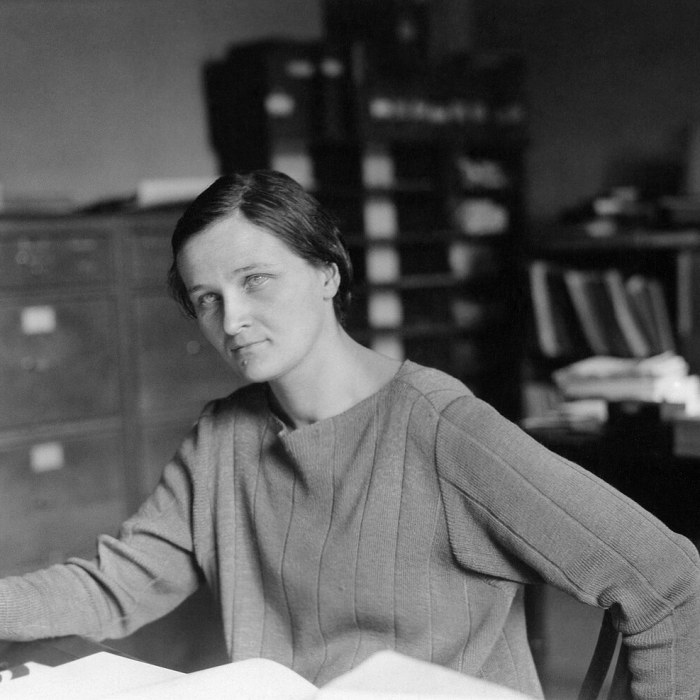
Cecilia Payne-Gaposchkin
Worked out what stars are made of, then was told to say she was probably wrong
Cecilia Payne was born in Wendover, Buckinghamshire, in 1900. Her father drowned when she was four. She won a scholarship to Newnham College, Cambridge, and in 1919 heard Arthur Eddington describe his eclipse expedition that had confirmed Einstein's relativity. She later said she barely slept for three nights and knew she had to be an astronomer. Cambridge, however, did not award degrees to women, and she saw no future for herself in England.
In 1923 she got a fellowship to the Harvard College Observatory. Two years later she completed the first doctorate in astronomy awarded there. Using new ideas about atoms and temperature, she analysed the spectra of stars and concluded that they were made overwhelmingly of hydrogen and helium, with the heavier elements a trace. This contradicted the accepted view that stars resembled the Earth in composition.
Henry Norris Russell, the most powerful astronomer in America, reviewed the thesis and told her the result was clearly impossible. She added a sentence saying it was almost certainly not real. Four years later Russell reached the same conclusion by another route and published it, and was generally credited with the discovery. Her thesis has since been called the most brilliant ever written in astronomy.
Harvard kept her on at low pay with no official position for years. She was not given the title of astronomer until 1938, or a professorship until 1956, when she became the first woman promoted to full professor in Harvard's Faculty of Arts and Sciences. She died in 1979.