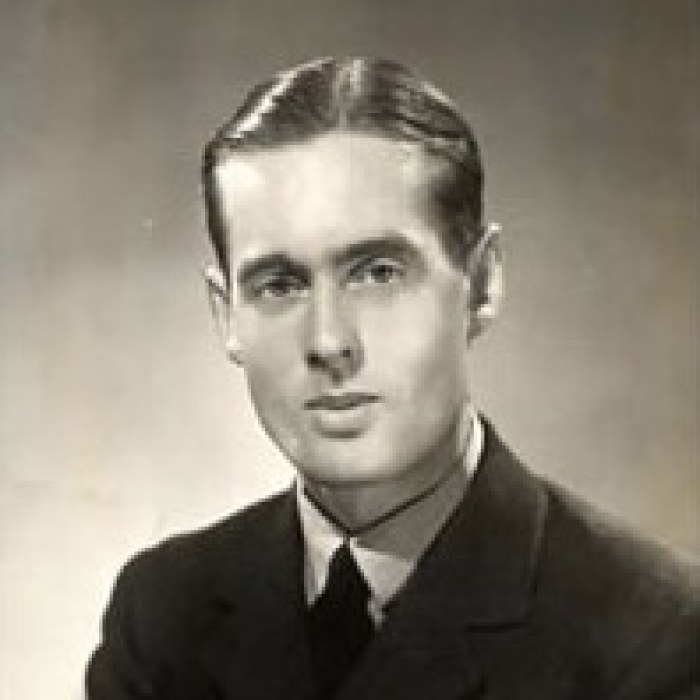
Leonard Cheshire
Watched the bomb fall on Nagasaki, then took a dying man into his house and nursed him
Leonard Cheshire was a clever, reckless Oxford undergraduate who joined the RAF before the war and became one of its most celebrated bomber pilots. He flew a hundred operations, commanded 617 Squadron and pioneered low-level target marking, and was awarded the Victoria Cross in 1944 for sustained courage rather than a single act. In August 1945 he was the official British observer aboard the aircraft that accompanied the atomic bombing of Nagasaki.
Peace left him lost. He tried to set up a self-supporting community for ex-servicemen at Le Court, a large house in Hampshire, and it fell apart within two years, leaving him with debts and an empty building. In 1948 a hospital telephoned about Arthur Dykes, a former member of the community who was dying of cancer and had no one. Cheshire took him in and, with no nursing experience, looked after him himself, learning as he went. Dykes' faith prompted Cheshire's own conversion to Catholicism.
Others came, sent by hospitals with nowhere else to put them: people with disabilities and incurable illnesses. Cheshire never planned an organisation. But by the time he married Sue Ryder in 1959 there were Cheshire Homes across Britain and in India, and eventually they existed in more than fifty countries, run on the principle that residents should decide how they lived.
He was given the Order of Merit in 1981 and a life peerage in 1991. He died of motor neurone disease the following year.