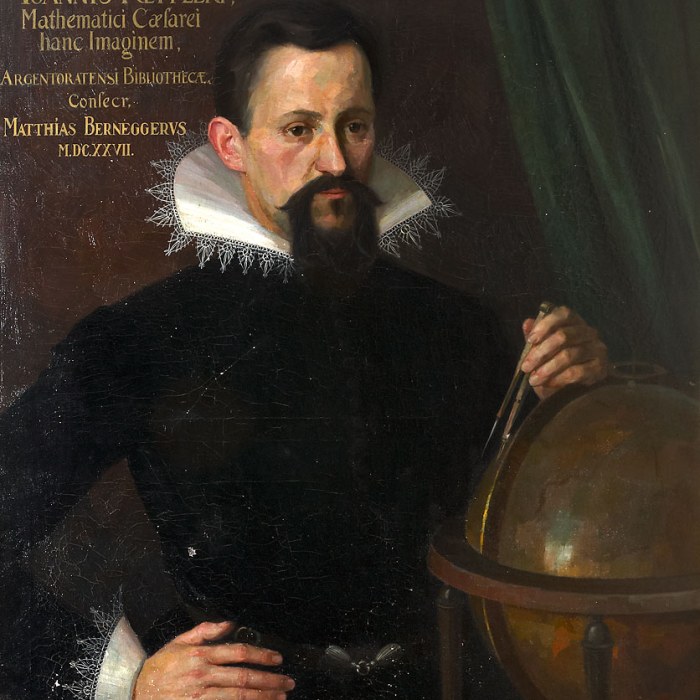
Johannes Kepler
Found the true shape of planetary orbits while defending his mother against a charge of witchcraft
Johannes Kepler was born prematurely in 1571 in the small town of Weil der Stadt, in what is now south-west Germany. His father was a mercenary who left the family for good when the boy was five. A bout of smallpox in childhood damaged his eyesight and crippled his hands, which ruled out the astronomer's work of observing. He would have to think instead.
He was a brilliant student and got a scholarship to Tübingen, intending to become a Lutheran minister. He was sent instead to teach mathematics in Graz, where he became convinced the planets moved around the Sun and was later expelled with other Protestants. In 1600 he went to Prague to work for Tycho Brahe, who had the most accurate observations of the heavens ever made and guarded them jealously. Tycho died the following year and Kepler inherited the data.
He spent almost a decade on the orbit of Mars, which refused to fit any combination of circles. In the end he abandoned two thousand years of assumption and showed the orbit was an ellipse, with the Sun at one focus, and that a planet sweeps out equal areas in equal times. His third law, linking a planet's period to its distance, followed in 1619.
He did this amid disaster. His wife and a son died in 1611. From 1615 his mother was accused of witchcraft, and he spent six years on her defence; she was imprisoned for over a year and threatened with torture before he got her released. He died in 1630, travelling to collect unpaid wages.