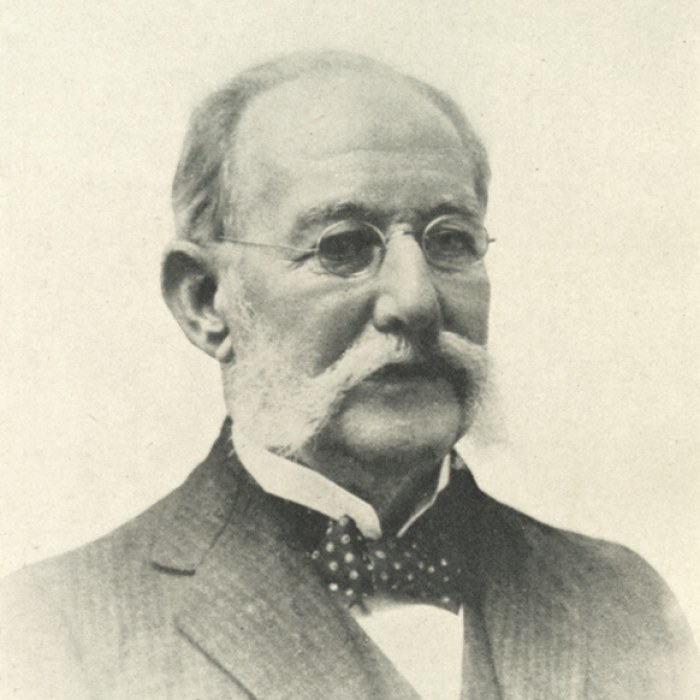
Carlos Finlay
Said mosquitoes carried yellow fever in 1881, and was laughed at for twenty years
Carlos Finlay was born in 1833 in Puerto Príncipe, Cuba, to a Scottish doctor and a French mother. A childhood illness left him with a speech impediment that never went away, and he was educated partly in France, where he was ill again. He qualified in medicine in Philadelphia in 1855 and settled in Havana.
Yellow fever was the great killer of the Caribbean, and nobody knew how it spread. Filth, bad air and contact with the sick were all blamed. Finlay noticed that epidemics followed the seasons and the temperature, and by 1881 had concluded that the disease was carried from one person to another by a particular mosquito, the one now called Aedes aegypti. He said so at a sanitary conference in Washington in February 1881, and in more detail to the Havana Academy of Sciences that August, where his paper met silence.
He spent the next two decades doing experiments with mosquitoes he had bred himself, feeding them on patients and then on volunteers, and publishing the results. They were inconclusive, partly because he did not know that the mosquito needed to wait days after biting before it could infect. The medical world treated him as an eccentric.
In 1900 the American army sent Walter Reed's commission to Havana. Finlay gave them his mosquito eggs and his reasoning. Within a year they had proved him right, and Havana was cleared of yellow fever by controlling mosquitoes. Finlay became Cuba's chief health officer and died in 1915.