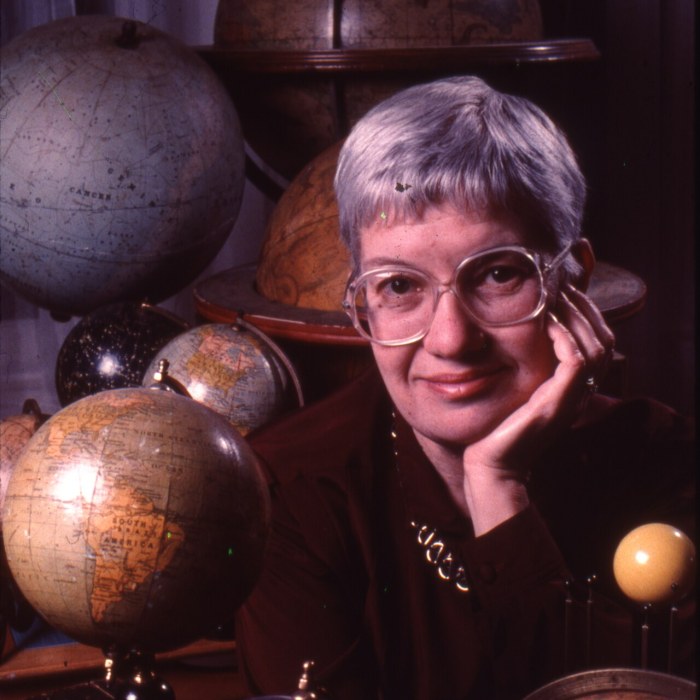
Vera Rubin
Showed that most of the universe is something we cannot see, and was told the result was impossible
Vera Cooper was born in Philadelphia in 1928 and watched the stars from her bedroom window in Washington, where the family moved. A teacher advised her to avoid science. She went to Vassar, the only astronomy major in her year, and applied to Princeton for graduate work, to be told that the department did not accept women. She went to Cornell instead, married, and did her doctorate at Georgetown in the evenings while her husband waited in the car.
For years she worked around her children, teaching part-time and following up ideas nobody else thought important. In 1965 she joined the Carnegie Institution's department in Washington, and became the first woman officially allowed to observe at the Palomar telescope, where there was no women's toilet; she cut out a paper skirt and stuck it on the door of the men's.
With Kent Ford and his new spectrograph she began measuring how fast stars orbit at different distances from the centres of galaxies. The expectation was that outer stars would move slowly, like outer planets. They did not. Rotation curves stayed flat right to the edge, which meant that galaxies were embedded in vast amounts of matter that gave off no light. She measured galaxy after galaxy, and the result was always the same.
Dark matter is now thought to make up most of the mass of the universe. Rubin never received a Nobel Prize. She died in 2016; a new observatory in Chile carries her name.