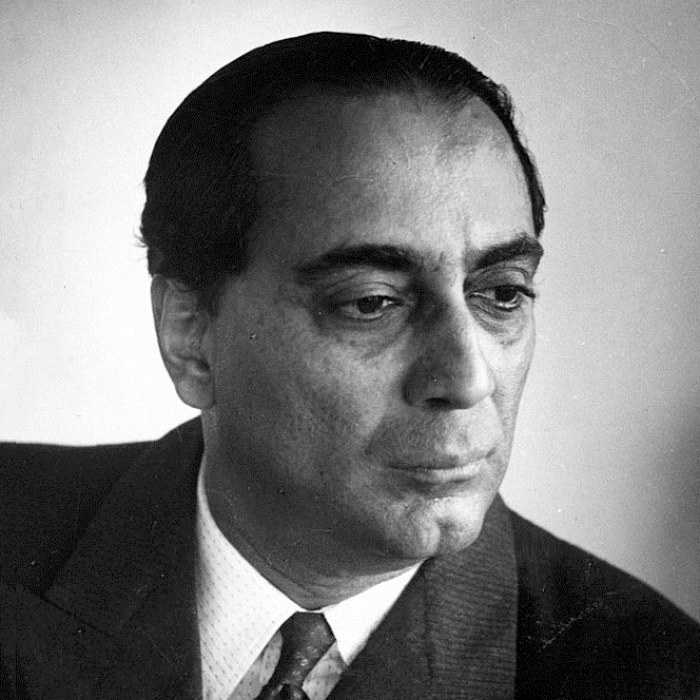
Homi Bhabha
Built India's nuclear research programme from scratch, then died in a plane crash at its height
Homi Jehangir Bhabha was born in 1909 into a wealthy Parsi family in Bombay and sent to Cambridge to study engineering, as his father wished, but he switched to physics and excelled at it, working on cosmic ray theory alongside some of the leading physicists of the 1930s. He was visiting India when the Second World War broke out and, unable to return to Europe, stayed and turned his energy toward building science at home instead.
With support from the industrialist J. R. D. Tata, he founded the Tata Institute of Fundamental Research in Bombay in 1945, aiming to create a centre where Indian physicists could do world-class work without leaving the country. After independence in 1947, Jawaharlal Nehru asked him to lead India's new atomic energy programme, and Bhabha built its institutions, laboratories and training programmes largely from scratch, arguing that nuclear science should serve development and energy needs rather than only weapons.
He became the public face of Indian science internationally, chairing the first United Nations conference on the peaceful uses of atomic energy in 1955, and pushed hard for India to pursue its own reactor technology rather than depend entirely on foreign suppliers.
In January 1966 he died when Air India Flight 101 crashed into Mont Blanc en route to a conference in Vienna, cutting short a programme he had spent two decades building.