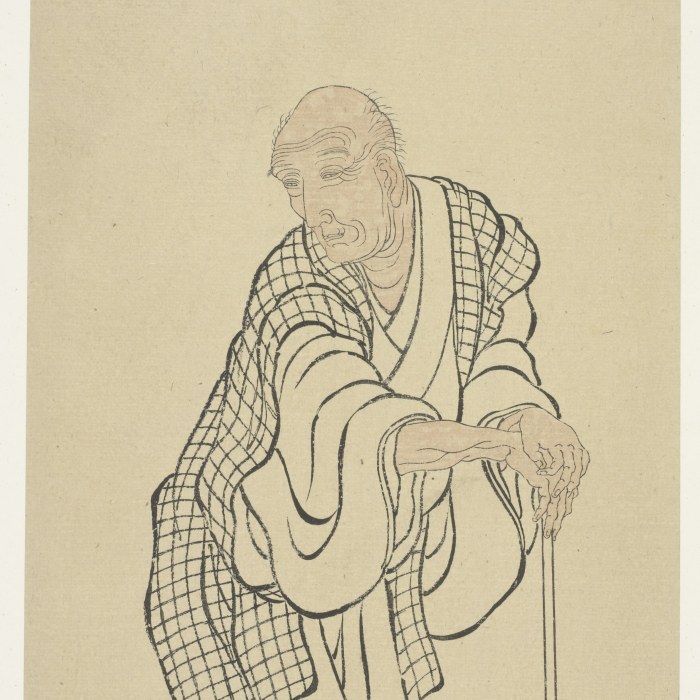
Hokusai
Made The Great Wave at 70, after a stroke and a lifetime of poverty, and thought his real work was still ahead
Katsushika Hokusai was born in Edo, now Tokyo, and was apprenticed to a woodblock engraver as a boy before joining the studio of a print master, who later expelled him. He would sign his work under more than thirty names during his life and moved house over ninety times, sometimes, it was said, because he never cleaned and simply left when the place became unbearable.
For decades he made a modest living designing prints, illustrating novels and producing sketchbooks, the Manga, that ran to fifteen volumes. He was often poor. In his late sixties, in 1827, he suffered a stroke and treated himself with a folk remedy of citrus and sake, teaching himself to draw again. His wife died the following year and his grandson ran up gambling debts that he had to pay off.
It was after all this, around the age of seventy, that he produced the Thirty-six Views of Mount Fuji, including the image of a great wave with the mountain small beneath it that has become the best-known work of Japanese art. In a postscript written in his mid-seventies he said that nothing he had done before seventy was worth much, that at 90 he might penetrate the mystery of things, and at 110 every dot and line would be alive.
A fire destroyed his studio and most of his drawings when he was 79. He kept working. On his deathbed in 1849, aged 88, he is recorded as saying that with another five years he could have become a real painter.