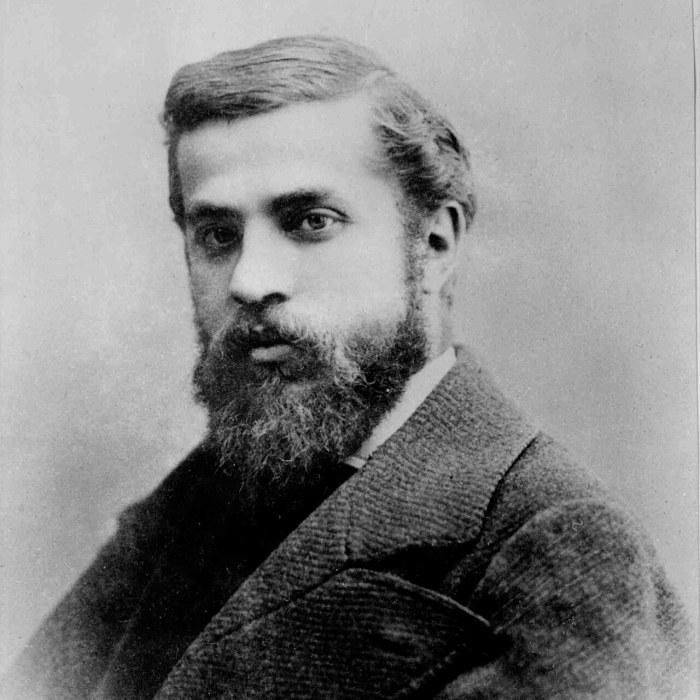
Antoni Gaudí
Spent his last years living in his workshop, building a cathedral he knew he would never finish
Antoni Gaudi was born in the Catalan countryside to a family of coppersmiths. Rheumatic illness kept him out of school for long stretches as a child, and he spent the time outdoors, looking at the way trees branched and shells curved. He would later say that everything he built came from the book of nature.
He was a poor student in architecture school in Barcelona, prone to arguing with his teachers. When he graduated in 1878 the head of the school is said to have remarked that he did not know whether they were giving the diploma to a madman or a genius. A wealthy industrialist, Eusebi Guell, took the risk and became his patron for thirty years.
Gaudi's buildings, with their rippling stone, broken-tile mosaics and columns that lean like trees, made him famous and divided opinion in Barcelona. In 1883 he took over the design of a church, the Sagrada Familia, and from 1914 he worked on nothing else, turning down other commissions and eventually moving into a small room in the workshop on the site. Funds came from donations, and he went door to door asking for them. He knew the building would take generations.
On 7 June 1926 he was hit by a tram while walking to prayers. Shabbily dressed and carrying no papers, he was taken for a beggar and left for hours before anyone recognised him. He died three days later and is buried in the crypt of his church.