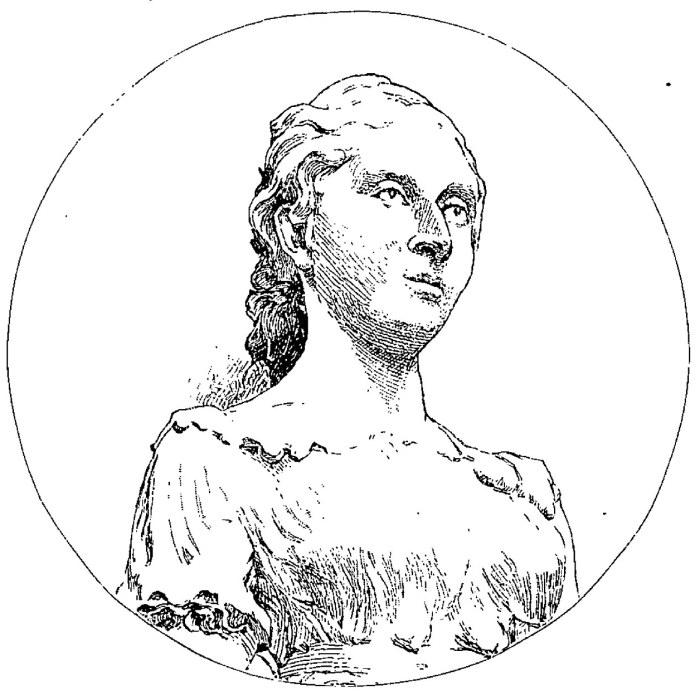
Sophie Germain
Studied by candlelight when her parents took away her fire and clothes, and won over Gauss under a false name
Sophie Germain was 13 when the Revolution began, and was kept indoors in Paris. In her father's library she read the story of Archimedes, killed by a Roman soldier because he was too absorbed in a geometry problem to answer, and decided that anything that gripping was worth learning. Her parents thought mathematics unsuitable for a girl. They took away her fire, her candles and her warm clothes at night. She wrapped herself in blankets and worked until the ink froze. Eventually they gave up.
When the École Polytechnique opened in 1794 women could not enrol, but lecture notes were available. She obtained them and submitted work to the mathematician Lagrange under the name of a male student, LeBlanc. Lagrange was impressed enough to ask to meet the author, discovered she was a woman, and became her mentor.
She used the same false name to write to Carl Friedrich Gauss about number theory. When Napoleon's army invaded Gauss's home in 1806, she asked a family friend, a French general, to make sure he was safe. Gauss learned his correspondent was a woman and wrote of her "noble courage" in overcoming the obstacles put in her way.
Her most substantial work was on the mathematics of vibrating surfaces. After two rejected attempts she won the Paris Academy's prize in 1816, the first woman to do so, though she never formally attended its sessions. Her results on Fermat's Last Theorem stood for a century. She died of breast cancer in 1831.