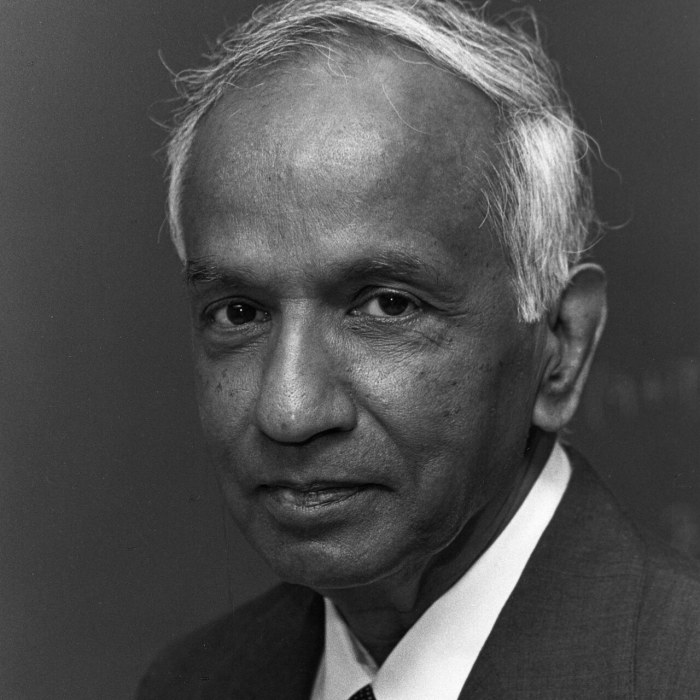
Subrahmanyan Chandrasekhar
Ridiculed at 24 by the most famous astronomer alive, he was proved right and won the Nobel Prize at 73
Subrahmanyan Chandrasekhar was born in Lahore in 1910 into a Tamil family that prized learning; his uncle, C. V. Raman, would win the Nobel Prize in Physics in 1930. He was taught at home until he was 12, published his first paper as an undergraduate in Madras, and won a scholarship to Cambridge.
On the sea voyage to England in 1930, aged 19, he worked through what would happen to a star once it ran out of fuel. Above a certain mass, about 1.4 times that of the Sun, nothing could stop it collapsing under its own gravity. He spent the next years developing the result, and in January 1935 presented it to the Royal Astronomical Society in London.
Arthur Eddington, the most eminent astrophysicist in the world and a man he thought of as a mentor, stood up next and, to laughter from the room, dismissed it as absurd, declaring there must be a law of nature to stop a star behaving in such a way. Chandrasekhar was 24 and Eddington had not warned him. Other physicists privately agreed with the young man but would not say so publicly. He left Britain for the University of Chicago in 1937, feeling there was no place for him.
There he stayed for nearly 60 years, moving from one field to another and writing a definitive book on each. He once drove a hundred miles each way through winter to teach a class of two students; both later won the Nobel Prize. He won his own in 1983, for the work Eddington had mocked. The Chandra X-ray Observatory is named after him. He died in 1995.