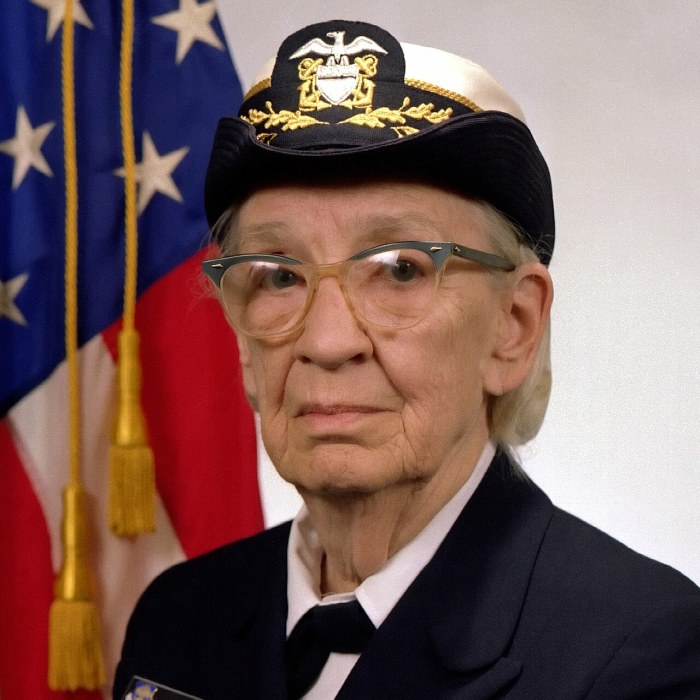
Grace Hopper
Wrote the first compiler and made computers speak something like English
Grace Brewster Murray took apart seven alarm clocks at the age of seven to see how they worked. She earned a doctorate in mathematics from Yale in 1934, when very few women did, and was teaching at Vassar when the United States entered the Second World War. She was too old and too light to enlist, but got an exemption and joined the Navy Reserve in 1943.
She was posted to Harvard to work on the Mark I, a 15-metre-long electromechanical calculator, and wrote its operating manual. In 1947 her team traced a fault in the Mark II to a moth stuck in a relay and taped it into the logbook, which is why we still talk about computer "bugs".
Her big idea came in the early 1950s. Programmers were writing instructions in numeric machine code, and she argued that they should be able to write in something closer to English and let the computer do the translation. Colleagues said computers could not understand English. She built the first compiler anyway, and her work led directly to COBOL, a language that was running most of the world's business systems for decades and still runs a surprising amount today.
The Navy retired her at 60, called her back seven months later, and did not finally let her go until 1986, when she was a rear admiral and, at 79, the oldest serving officer in the US armed forces. She carried lengths of wire cut to the distance electricity travels in a nanosecond to explain to admirals why satellite signals took time. A guided-missile destroyer bears her name.