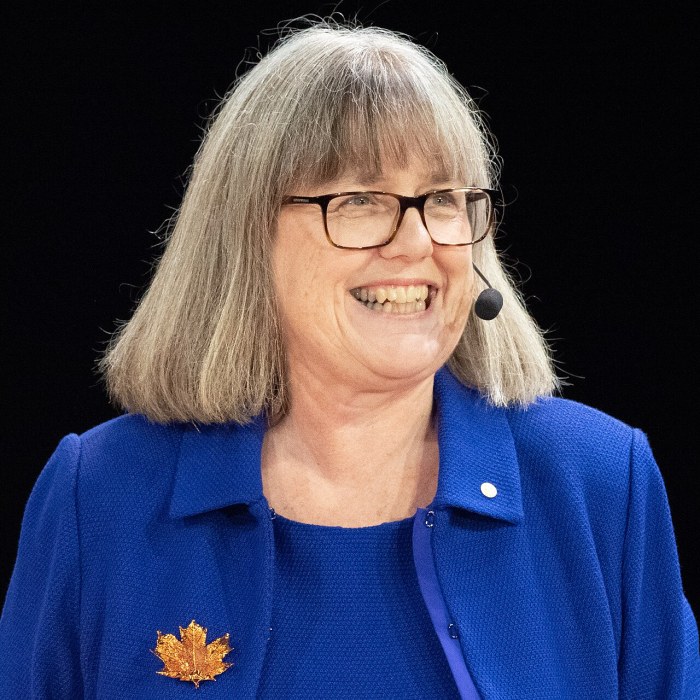
Donna Strickland
Never bothered to apply for a full professorship, and won the Nobel Prize for her first research paper
Donna Strickland was born in Guelph, Ontario, in 1959. Her father was an electrical engineer and her mother a teacher, and she chose engineering physics at McMaster University because it mentioned lasers, which she thought sounded exciting. She was one of three women in a class of twenty-five.
At the University of Rochester in the mid-1980s, working under Gérard Mourou, she took on a problem that had stalled laser research. Everyone wanted more intense pulses of light, but pushing more energy through the amplifiers destroyed them. Her idea, worked out over long days and involving a great deal of fibre optic cable that refused to behave, was to stretch each pulse out in time first, amplify it safely while it was long and weak, and then compress it back. The method, chirped pulse amplification, was described in a short paper in 1985. It was the first paper she had ever published.
It made the most intense laser pulses in the world possible and is now used in laser eye surgery, in cutting glass for phone screens and in physics laboratories everywhere. Strickland, meanwhile, held a series of research posts, moved to the University of Waterloo in 1997, and stayed an associate professor for twenty years. Asked why, she said she had never applied for promotion because she did not need to.
In 2018 she shared the Nobel Prize in Physics with Mourou and Arthur Ashkin. At the time she had no Wikipedia page; a draft had been rejected months earlier.