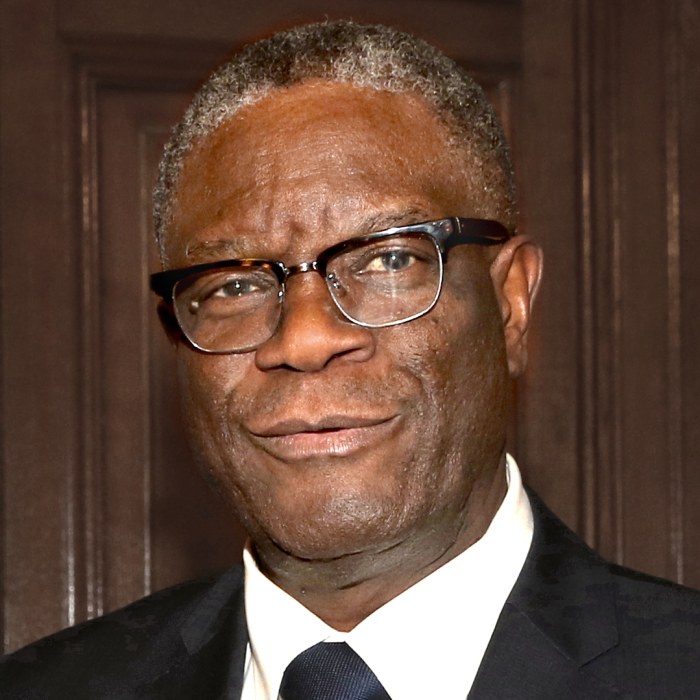
Denis Mukwege
The Congolese surgeon who has repaired tens of thousands of women brutalised by war
Denis Mukwege grew up in Bukavu in the east of the Democratic Republic of the Congo, the son of a Pentecostal pastor, and decided as a boy to become a doctor after watching his father pray for a sick child he could do nothing else for. He studied medicine in Burundi and obstetrics in France, and returned to run the hospital at Lemera, in the hills south of Bukavu.
In 1996 the war that would consume the region reached Lemera. The hospital was attacked, patients and staff were murdered, and it was destroyed. Mukwege started again in Bukavu, and in 1999 opened Panzi Hospital in a suburb of the city, intending it for safe childbirth. His first patient had been raped and then shot in the thighs and genitals. More followed, women and girls and sometimes infants, injured with a deliberateness that he came to understand as a weapon of war intended to destroy communities.
He and his team have operated on tens of thousands of such patients, developing surgical techniques as they went, and Panzi added legal aid, psychological care and a way for women to earn a living afterwards. Mukwege has been outspoken about who is responsible, including the Congolese state and neighbouring governments.
In October 2012, weeks after a speech at the United Nations, gunmen entered his home and held his daughters; his guard was killed and he narrowly escaped. He left the country, and returned in January 2013 after Bukavu women raised money for his ticket. He won the Nobel Peace Prize in 2018 with Nadia Murad.