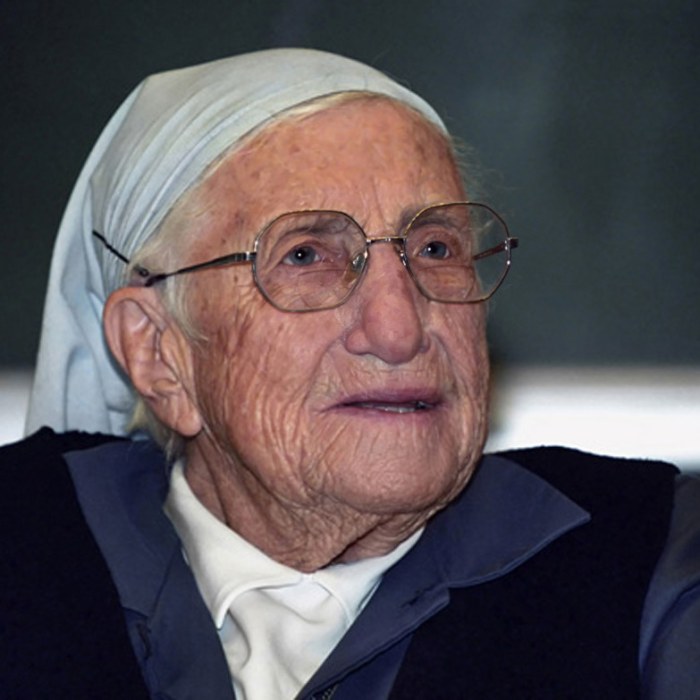
Sister Emmanuelle
At 62, a convent teacher of rich girls moved into the rubbish-pickers' slums of Cairo for 22 years
Madeleine Cinquin was born in Brussels in 1908 to a French father and a Belgian mother. When she was six she watched her father drown while swimming at Ostend, and she said the loss shaped both her faith and her impatience with wasting time. She joined the Sisters of Notre-Dame de Sion in her twenties, taking the name Emmanuelle, and spent the next forty years teaching literature and philosophy to the daughters of wealthy families in Istanbul, Tunis and Alexandria.
She was good at it and increasingly uneasy about it. In 1971, aged sixty-two, with her order's reluctant consent, she went to live in Ezbet el-Nakhl, a district on the edge of Cairo where the zabbaleen, the city's Christian rubbish collectors, sorted refuse by hand and lived among pigs and rats. She took a hut with no water or electricity and stayed for twenty-two years.
She was not a natural saint: she was bossy, quick-tempered and, by her own frank account, tempted throughout her life by pride and by the body. But she got things done. She nagged embassies, companies and the Egyptian government, opened a school, then a dispensary, a compost plant and workshops, and in 1980 founded an association, now called Asmae, to carry the work on. Her cry of Yalla, meaning let's go, became her trademark.
Her order recalled her to France in 1993. She spent her last years in a home for elderly nuns in the Var and died in October 2008, weeks short of her hundredth birthday.