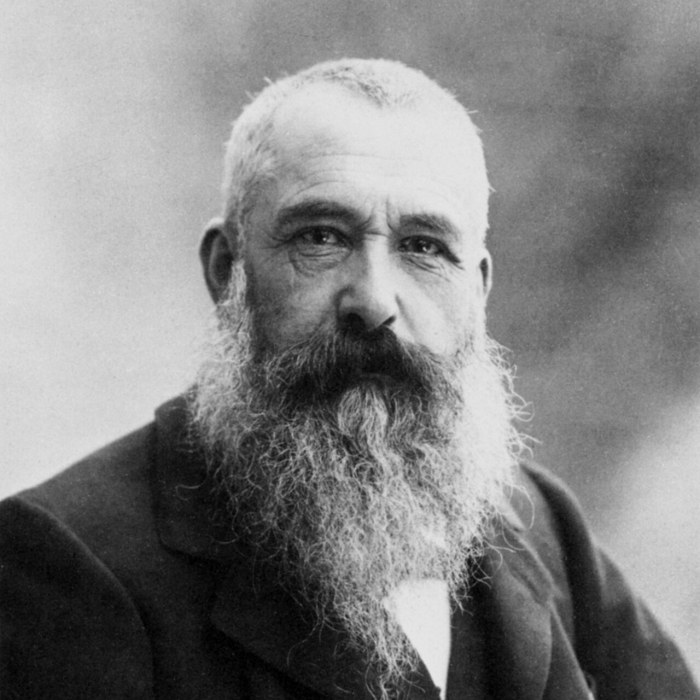
Claude Monet
Mocked, broke and half blind, he painted the water lilies that fill two rooms in Paris
Claude Monet grew up in Le Havre, where he sold caricatures as a teenager and was persuaded by the painter Eugene Boudin to go outside and paint the sea and sky directly. His family disapproved of art as a career and cut off his allowance when he refused to follow the conventional academic path.
The 1860s and 1870s were years of rejection by the official Salon, unpaid bills, moonlight flits from landlords and begging letters to friends. In 1868, with a young son and no money, he wrote that he had thrown himself into the Seine. He survived. In 1874 he and his friends organised their own exhibition; a critic, sneering at a canvas titled Impression, Sunrise, called the whole group Impressionists, and the insult became the name of a movement.
His wife Camille died in 1879, aged 32. He painted her on her deathbed and later confessed to being ashamed that he had found himself studying the colours in her face. Only in the 1880s did the paintings begin to sell.
In 1883 he settled at Giverny, dug a pond, planted water lilies and spent the last three decades of his life painting them. Cataracts, diagnosed in 1912, gradually turned everything he saw muddy and reddish; he painted from memory of what colours should be, and had surgery on one eye in 1923. The vast Water Lilies panels he gave to France were installed in the Orangerie in Paris the year after his death in 1926.