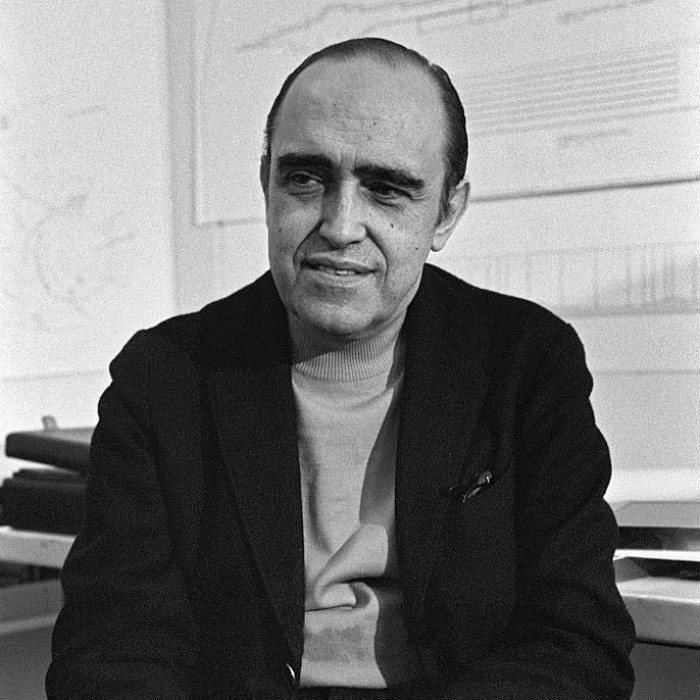
Oscar Niemeyer
Built a capital city in the desert, was driven into exile by a coup and kept designing until 104
Oscar Niemeyer was born in Rio de Janeiro and drifted through his twenties, marrying young and working in his father\'s typesetting shop before qualifying as an architect in 1934. He asked Lúcio Costa, the leading modernist in Brazil, for a job and was taken on unpaid. Two years later he was in the team that worked with Le Corbusier on a new Ministry of Education building, and his sketches so impressed the visiting Frenchman that they were used.
In the 1940s a mayor in Minas Gerais, Juscelino Kubitschek, gave him a lakeside suburb to design. When Kubitschek became president in 1956 he gave him a capital city. Brasília rose in four years on the empty central plateau, with Costa laying out the plan and Niemeyer designing the Congress, the cathedral and the presidential palace as sweeps and curves of white concrete that people either loved or thought inhuman.
He had joined the Communist Party in 1945 and never left it. After the military coup of 1964 his office was raided, his magazine closed and his commissions dried up; a minister declared that the place for communist architects was Moscow. He went to Paris instead, designing the French Communist Party headquarters and a university in Algeria, and did not come home for good until the 1980s.
He won the Pritzker Prize in 1988, designed the saucer-shaped art museum at Niterói at 89, and kept working in his studio overlooking Copacabana until he died in 2012, ten days short of 105.